
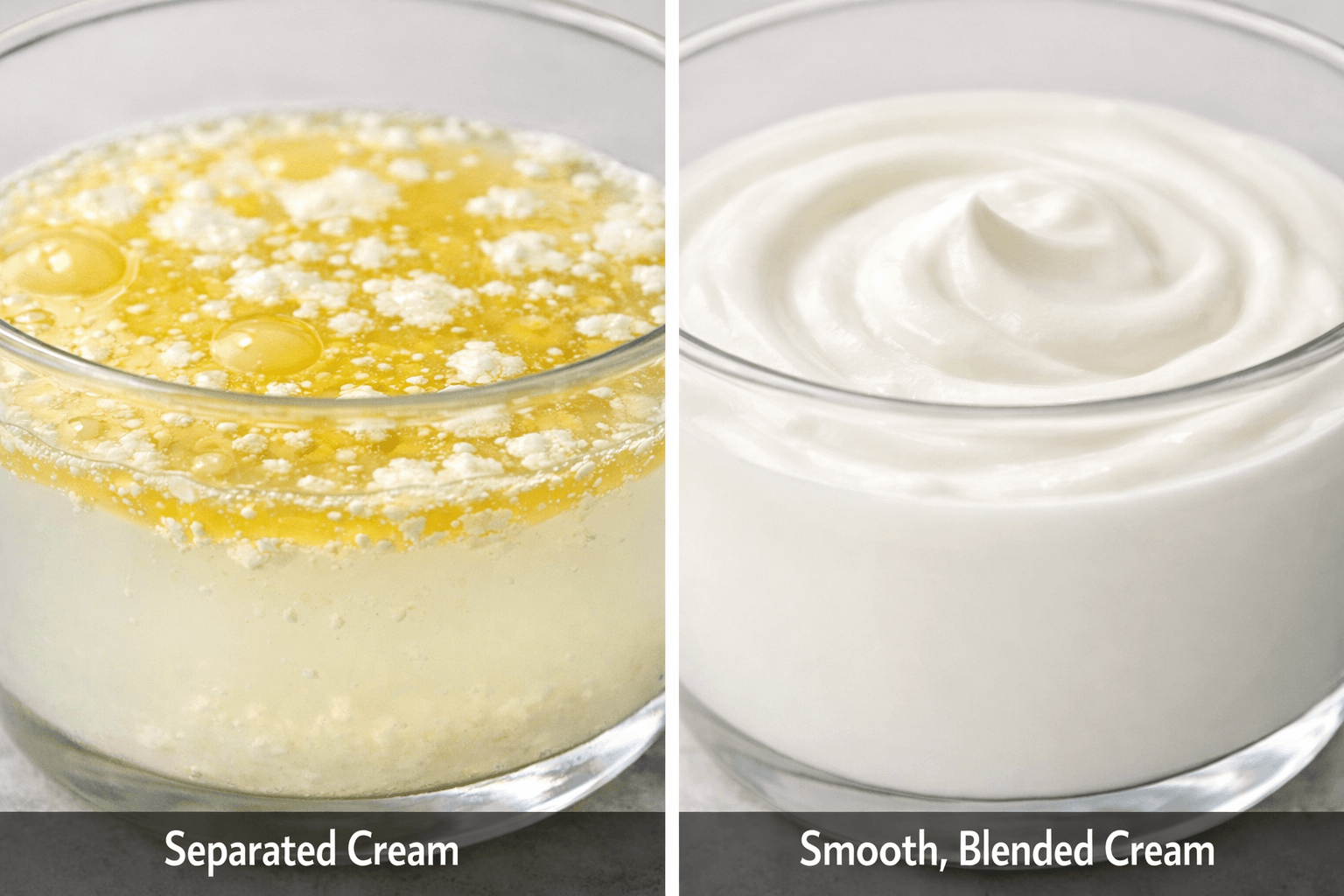
You followed the recipe exactly. You measured everything carefully. You were so proud of your beautiful, smooth body cream.
Then you woke up the next morning, opened the jar, and your heart sank. There’s a layer of oil floating on top. The water and oil have completely separated. Your “perfect” cream now looks like a science experiment gone wrong.
I know this frustration personally. Moreover, I’ve received countless calls from heartbroken formulators asking, “What did I do wrong?” Sometimes they’ve already thrown away three batches, wasted ingredients, and are ready to give up entirely.
Here’s what you need to understand: cream separation is one of the most common problems in DIY skincare. In fact, it happens to almost everyone when they start. The good news? It’s usually fixable, and once you understand why it happens, you can prevent it forever.
Today, I’m going to show you exactly why your cream separated, how to fix it (yes, even already-separated cream!), and most importantly, how to make sure it never happens again.
Before we fix anything, let’s understand what went wrong.
Body cream is what scientists call an “emulsion” a mixture of oil and water held together by an emulsifier. Think of mayonnaise: egg yolk holds oil and vinegar together. Without that egg yolk, the oil and vinegar would separate immediately.
Your body cream works the same way. You have:
When your cream separates, it means the emulsifier failed to keep the oil and water bound together. As a result, they’ve returned to their natural state separate layers.
Here’s the thing: This isn’t always your fault. Sometimes it’s the ingredients, the temperature, or even how you mixed it. Let’s figure out what happened to YOUR cream specifically.
This is the number one culprit.
Many beginners think, “I’ll just mix shea butter and water really well, and it’ll stay together.” Unfortunately, that’s not how chemistry works. Without a proper emulsifier, oil and water will always separate it’s just a matter of time.
Common mistakes:
The fix: You need a proper emulsifier like Emulsifying Wax NF, BTMS, or Polawax. Furthermore, you need to use the correct percentage typically 5-6% of your total formula weight.
Temperature matters more than most people realize.
Emulsions form properly only when both your oil phase and water phase are at the correct temperature usually 70-75°C. If one phase is too hot and the other too cool, the emulsifier can’t do its job properly.
Common mistakes:
Additionally, some emulsifiers need specific temperature ranges to activate. For instance, some won’t work below 70°C, while others break down above 80°C.
The fix: Always heat both phases to the same temperature (70-75°C). Use a reliable thermometer, not your finger or guesswork. Then, combine them while they’re both at this temperature.
The order you mix your phases matters significantly.
Generally, you should add the oil phase TO the water phase, not the other way around. This is because water is usually the larger portion of your formula, and adding the smaller amount to the larger amount creates better emulsion stability.
Common mistakes:
The fix: Heat both phases separately to 70-75°C. Then, slowly pour your oil phase into your water phase while continuously stirring or blending. This creates a more stable emulsion from the start.
Creating a stable emulsion requires proper mixing. Consequently, you need to blend thoroughly to create tiny oil droplets dispersed evenly throughout the water phase.
Common mistakes:
You’ll know your emulsion is forming when the mixture changes from translucent/oily-looking to opaque/creamy-looking. This usually takes 3-5 minutes of continuous blending.
The fix: Use a hand mixer or stick blender. Mix continuously for 3-5 minutes until the mixture turns creamy and opaque. Then, continue stirring gently as it cools to room temperature (this can take 15-30 minutes).
Timing is everything in formulation.
Certain ingredients must be added at specific temperatures. For example, preservatives and fragrance oils typically go in at 40°C or below because heat can damage them. However, if you add water-based actives too early, they might interfere with emulsion formation.
Common mistakes:
The fix: Follow this sequence:
Every emulsifier has a limit to how much oil it can hold in water. If you use too much oil for the amount of emulsifier you have, the emulsion will fail.
Most body cream formulas work well with:
Common mistakes:
The fix: Stick to proven ratios. If you want a richer cream with more oils, you need to increase your emulsifier percentage accordingly.
Sometimes, the problem isn’t what you did it’s what you used.
Old, rancid oils, contaminated water, or poor-quality emulsifiers can prevent proper emulsion formation. Moreover, if your equipment wasn’t clean, bacteria or residue can interfere with the process.
Common mistakes:
The fix: Always use fresh, quality ingredients from reliable suppliers. Use distilled or de-ionized water, not tap water. Furthermore, sanitize all your equipment with 70% isopropyl alcohol before starting.
Now for the question everyone asks: “Can I save my separated cream, or do I have to throw it away?”
The answer depends on why it separated. Here’s how to troubleshoot:
This works if the separation is due to temperature issues or insufficient mixing.
Steps:
Success rate: About 60-70% if the issue was temperature or mixing
If you didn’t use enough emulsifier initially, you can add more.
Steps:
Success rate: About 50-60% if lack of emulsifier was the problem
If your cream separated because of:
Then it’s better to start fresh. Use the separated cream as a lesson, not a failure. Moreover, starting over with correct technique takes less time than trying to fix severely broken emulsion.
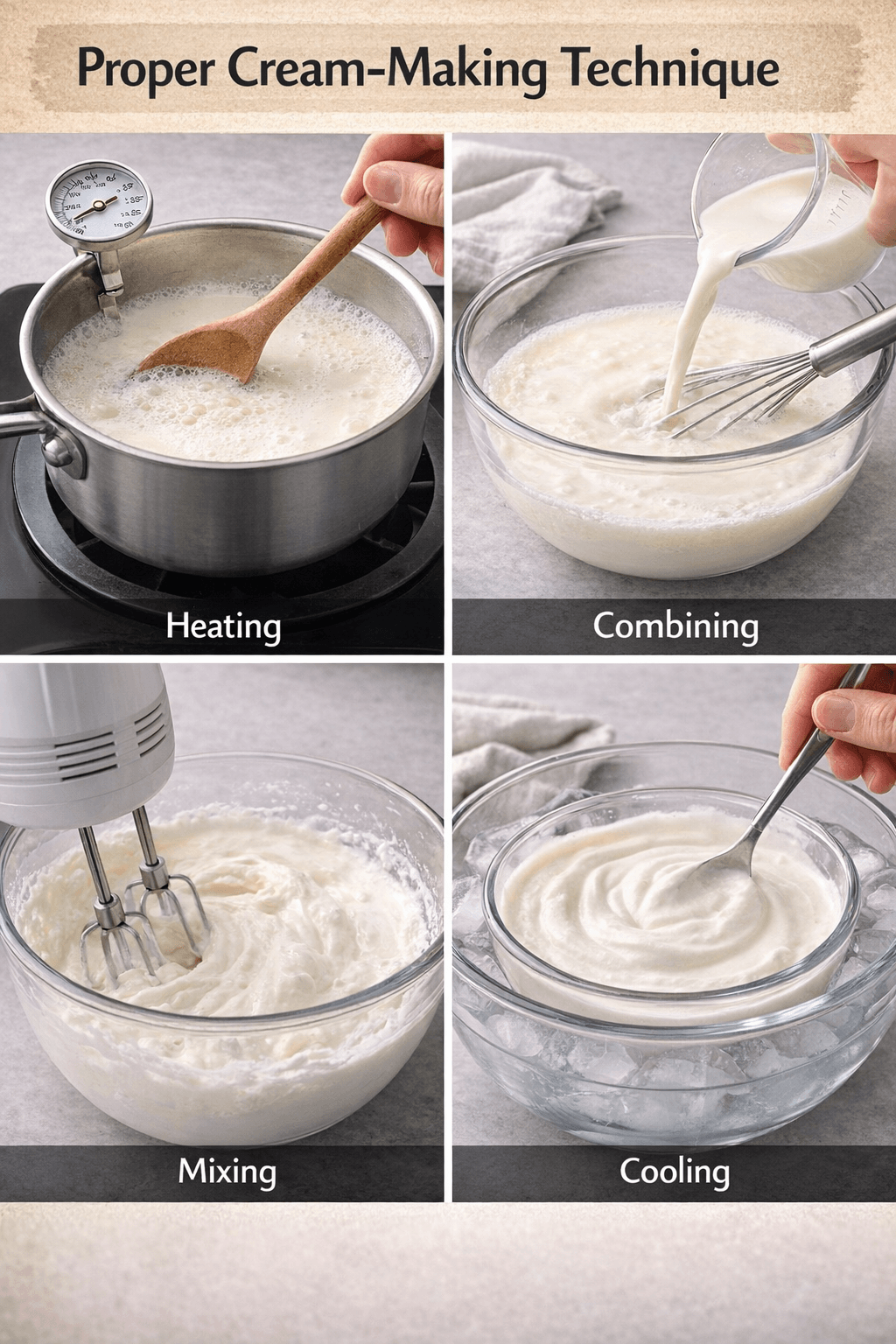
Now that you understand what causes separation, here’s your foolproof method for perfect cream every time:
Don’t experiment wildly on your first few batches. Instead, follow tested recipes with correct ratios. Once you master the basics, then you can start adjusting.
Basic stable formula:
Never measure by volume (cups, tablespoons). Weight is precise; volume is not. A kitchen scale that measures grams is essential.
Heat your oil phase and water phase in separate containers to 70-75°C. Use an actual thermometer don’t guess. Wait until both reach the same temperature before combining.
Slowly pour oil phase into water phase while using a hand mixer or stick blender. Don’t dump it all at once. Additionally, keep blending continuously.
Continue blending for 3-5 minutes. You’ll see the mixture change from translucent to opaque, creamy white. This visual change tells you emulsion is forming.
As the mixture cools, stir occasionally (every few minutes). This prevents separation during the cooling process. The mixture will thicken as it cools.
When temperature reaches 40°C or below, add your preservative, fragrance, and heat-sensitive ingredients. Mix gently but thoroughly.
Don’t immediately package your cream. Let it sit overnight. Check it the next day. If it’s still beautifully emulsified after 24 hours, it’s stable. Then you can package it.
Our hot, humid weather adds extra challenges. Here’s what works:
Temperature management: Our room temperature is often 28-32°C, which means your cream stays softer. This is normal. However, if it’s separating, don’t blame the weather it’s usually technique.
Storage: Keep finished cream in cool places, away from direct sunlight. Heat accelerates separation in unstable formulas.
Testing: Always test your formula during both rainy season (high humidity) and dry season (harmattan). Stability can vary with climate changes.
Ingredient selection: Some emulsifiers work better in tropical climates. Emulsifying Wax NF and BTMS both perform well in Nigerian conditions.
“How long should my cream stay emulsified?” A properly made cream with preservative should stay stable for 3-6 months when stored correctly. If it separates within days or weeks, something went wrong in the formulation.
“Can I use beeswax instead of emulsifying wax?” No. Beeswax is not a true emulsifier. It can thicken formulas, but it won’t create stable oil-in-water emulsions. You need actual emulsifying wax.
“Does adding more glycerine help prevent separation?” Not really. Glycerine is a humectant (attracts moisture), not an emulsifier. While it’s great for hydration, it won’t prevent separation. That’s the emulsifier’s job.
“My cream is lumpy, not separated. Is that the same thing?” Lumps usually mean incomplete melting or mixing. Heat everything properly until fully melted, then blend thoroughly. Lumps are easier to fix than separation.
Throw it away if:
Try to fix it if:
Remember: your time has value. Sometimes starting fresh with correct technique is smarter than spending hours trying to save a failed batch.
Before you make your next batch, ensure you have:
✅ Proper emulsifying wax (not regular beeswax) ✅ Digital kitchen scale that measures grams ✅ Thermometer (preferably digital) ✅ Hand mixer or stick blender ✅ Clean, sanitized equipment ✅ Fresh, quality ingredients ([quality raw materials] from reliable suppliers) ✅ Distilled or de-ionized water ✅ Proven recipe with correct ratios ✅ Patience to follow the process properly
Here’s something I want you to understand: even experienced formulators occasionally get separation. The difference? They know exactly why it happened and how to prevent it next time.
Your separated cream isn’t failure it’s education. Every batch teaches you something. Moreover, once you master stable emulsions, you can create countless products: body creams, lotions, face creams, hair conditioners, and more.
The formulators now running successful skincare businesses? They’ve all had cream separation disasters. The difference between them and people who quit? They learned from mistakes instead of giving up.
Now you know the seven main reasons cream separates, how to fix it, and most importantly, how to prevent it forever.
Your next step? Make a fresh batch using proper technique. Follow the temperature guidelines. Use correct ratios. Mix thoroughly. Be patient during cooling.
When you open that jar tomorrow morning and see perfectly smooth, stable cream, you’ll feel incredible. That’s the moment everything clicks.
And if it separates again? Come back to this article. Troubleshoot methodically. Figure out which of the seven reasons applies. Adjust and try again.
Persistence + proper technique = perfect cream every single time.
Ready to make stable, professional cream that never separates? Source your [emulsifying wax], [shea butter], and other quality ingredients from reliable suppliers who stand behind their products.
Have you experienced cream separation? What was your biggest challenge? Share in the comments below—let’s learn from each other’s experiences!