
Castor Oil for Hair Growth: Does It Really Work? (Honest Review)
Let me be completely honest with you from the start.
I’ve seen the claims. “Grow 4 inches in one month!” “Bald edges restored in two weeks!” “The miracle oil your hair has been waiting for!” Moreover, I’ve watched Nigerian women spend thousands of naira on castor oil products based on these promises, only to feel disappointed when results don’t match expectations.
So today, we’re having a real conversation about castor oil for hair growth. No exaggerated claims, no miracle stories, no pressure to buy anything. Instead, I’m giving you the honest, science-backed truth about what castor oil actually does for your hair, what it absolutely cannot do, and how to use it correctly for real results.
By the end of this article, you’ll know exactly whether castor oil deserves a place in your hair care routine. Furthermore, you’ll know precisely how to use it for maximum benefit.
Let’s get into it.
What Exactly is Castor Oil?
Before we discuss results, let’s understand what we’re actually talking about.
Castor oil comes from the seeds of the Ricinus communis plant, which grows abundantly across Africa, including Nigeria. Additionally, it’s been used for centuries across the continent for skin, hair, and medicinal purposes.
There are two main types you’ll find in the Nigerian market:
Regular Castor Oil (Cold-Pressed) This is the standard, pale yellow version. It’s extracted by cold-pressing castor beans without heat or chemicals. Consequently, it retains all its natural nutrients and beneficial compounds.
Jamaican Black Castor Oil (JBCO) This version is made by roasting castor beans before pressing them. As a result, the roasting process creates ash that makes the oil darker and slightly more alkaline. Many people believe JBCO is more effective for hair growth, though scientific evidence on this specific claim is limited.
The key ingredient in both: Ricinoleic acid. This unique fatty acid makes up about 90% of castor oil and is responsible for most of its benefits. Furthermore, ricinoleic acid is found in almost no other natural oil, making castor oil genuinely unique.
What Does the Science Actually Say?
Here’s where I need to be really honest with you.
The scientific research on castor oil specifically for hair growth is surprisingly limited. In fact, there are very few large-scale clinical studies proving that castor oil directly stimulates new hair growth in humans.
However, before you close this article, hear me out because the existing evidence is still meaningful.
What research DOES confirm:
A study published in the Journal of Cosmetic Science confirmed that ricinoleic acid has significant anti-inflammatory properties. Since scalp inflammation is a major cause of hair loss and slow growth, this is genuinely important. Consequently, reducing scalp inflammation creates a better environment for hair growth.
Additionally, research confirms that castor oil has strong antimicrobial properties. Therefore, it helps keep your scalp clean, healthy, and free from fungal issues that can block hair follicles.
Furthermore, studies on ricinoleic acid show it improves blood circulation when applied topically. Better blood flow to your scalp means more nutrients and oxygen reaching your hair follicles, which supports healthy growth.
What research does NOT confirm:
There are no large clinical studies proving castor oil directly causes new hair follicles to form. Moreover, the dramatic “4 inches in one month” claims you see online have no scientific backing whatsoever.
The honest bottom line: Castor oil creates the ideal conditions for healthy hair growth rather than magically forcing new growth. This distinction matters enormously when setting your expectations.
What Castor Oil Actually Does for Your Hair
Now that we’ve established the science, let’s talk about the real, proven benefits you can expect.
It Reduces Scalp Inflammation
Scalp inflammation is one of the most overlooked causes of slow hair growth and hair loss. Specifically, conditions like dandruff, scalp psoriasis, and product buildup cause chronic inflammation that slowly damages hair follicles.
Ricinoleic acid directly targets inflammation at the scalp level. Consequently, regular castor oil application can soothe an irritated scalp, reduce dandruff, and create a healthier foundation for growth. Furthermore, many people notice reduced itchiness within just 1-2 weeks of consistent use.
It Strengthens Hair and Reduces Breakage
This is arguably castor oil’s most powerful and most proven benefit for Nigerian hair.
Castor oil is extremely thick and coating. Therefore, it forms a protective layer around each hair strand that shields against breakage from manipulation, heat, and environmental damage.
Additionally, its high fatty acid content penetrates the hair cortex, strengthening the hair from within. As a result, your hair breaks less, and you retain more length. For many Nigerian women, this length retention is mistaken for accelerated growth. However, whether it’s new growth or retained length, the visible result is longer hair.
It Moisturizes Your Scalp
A dry, flaky scalp is a hostile environment for hair growth. Moreover, it causes itching that leads to scratching, which damages follicles further.
Castor oil is an excellent emollient that deeply moisturizes your scalp. Consequently, it reduces dryness, flakiness, and the discomfort that comes with a dry scalp. Furthermore, a well-moisturized scalp is significantly more receptive to growth.
It May Improve Blood Circulation
When you massage castor oil into your scalp (which you should always do), you combine two growth-stimulating activities. Specifically, the massage itself increases blood flow, while ricinoleic acid may enhance this circulation effect.
Better blood circulation means your follicles receive more nutrients and oxygen. Therefore, they’re better equipped to produce strong, healthy hair strands.
It Fights Scalp Infections
Fungal and bacterial scalp infections are more common than most people realize. In fact, they’re a leading cause of hair thinning and loss that often goes undiagnosed.
Castor oil’s antimicrobial properties help prevent and treat these infections. As a result, your scalp stays healthier and your follicles remain unblocked and productive.
What Castor Oil CANNOT Do (The Honest Part)
This section is where I earn your trust, because most beauty bloggers skip this part entirely.
It cannot regrow hair on completely bald scalps. If your hair follicles are damaged beyond repair or completely inactive for years, castor oil won’t revive them. In those cases, you need professional medical intervention.
It cannot override genetics. If hair loss runs in your family due to androgenetic alopecia (genetic hair thinning), castor oil alone won’t stop it. However, it can slow the process when combined with proper medical treatment.
It cannot deliver results overnight. Anyone promising you visible growth in one week is misleading you. Realistically, hair grows about 1-1.5cm per month on average. Therefore, castor oil can optimize this growth but cannot dramatically multiply it.
It cannot work without consistency. Using it once or twice won’t show results. In fact, you need at least 8-12 weeks of consistent use before making any judgments about effectiveness.
It cannot replace a healthy diet. Your hair grows from the inside out. Consequently, no topical oil can compensate for severe nutritional deficiencies. Eat protein, iron, and vitamins alongside your castor oil routine.
How to Use Castor Oil Correctly
Most people who “tried castor oil and it didn’t work” were using it incorrectly. Here’s the right way.
Method 1: Direct Scalp Application (Best for Growth)
This is the most effective method for targeting hair growth specifically.
Step 1: Part your hair into sections. Then, apply castor oil directly to your scalp along each part using a dropper bottle or your fingertips.
Step 2: Massage thoroughly for 5-10 minutes using circular motions. This step is non-negotiable because the massage dramatically increases the oil’s effectiveness by boosting circulation.
Step 3: Leave on for at least 2 hours. Alternatively, leave overnight for deeper penetration (cover with a satin bonnet).
Step 4: Wash out with shampoo. You may need to shampoo twice because castor oil is thick.
Frequency: 2-3 times per week for best results.
Method 2: Hot Oil Treatment (Best for Strength and Moisture)
This method targets the hair length rather than just the scalp.
Step 1: Mix castor oil with a lighter oil. Specifically, combine equal parts castor oil and Sweet Almond Oil or coconut oil. This makes the thick castor oil easier to spread through your hair.
Step 2: Warm the mixture gently by placing the bottle in hot water for 2-3 minutes.
Step 3: Apply to your scalp AND hair length, focusing on the ends.
Step 4: Cover with a shower cap and sit under a dryer for 20-30 minutes. Alternatively, wrap a warm towel around your head.
Step 5: Wash out thoroughly and condition as normal.
Frequency: Once per week as a deep treatment.
Method 3: Edges and Hairline Treatment (Best for Thin Edges)
Thin edges are a major concern for many Nigerian women, particularly those who wear tight styles regularly.
Step 1: Apply a small amount of castor oil to your edges using a clean mascara wand or your fingertips.
Step 2: Massage gently in circular motions for 3-5 minutes.
Step 3: Leave on overnight. Cover with a satin bonnet or scarf to protect your pillowcase.
Frequency: Every night for thinning edges, 3-4 times per week for maintenance.
The Best Castor Oil Mix for Nigerian Hair
Pure castor oil is extremely thick. Consequently, many people find it difficult to apply and rinse out. Therefore, mixing it with lighter oils dramatically improves the experience without reducing effectiveness.
Basic Growth Mix:
- Castor oil – 50ml
- Coconut Oil – 30ml
- Sweet Almond Oil – 20ml
- Rosemary essential oil – 10 drops
- Peppermint essential oil – 5 drops
Mix everything in a dark glass bottle. Shake well before each use. Apply using Method 1 for maximum growth benefits.
This combination gives you castor oil’s growth-promoting properties, coconut oil’s deep penetration, sweet almond oil’s lightweight nourishment, and essential oils’ circulation-boosting benefits all in one bottle.
Castor Oil for Different Hair Types
Nigerian women have diverse hair types and textures. Here’s how castor oil works for each:
For Natural Hair (4C, 4B, 4A)
Castor oil is excellent for natural hair because our tight coils are naturally dry and prone to breakage. Additionally, the thick coating property protects fragile natural hair beautifully.
Best application: Hot oil treatment mixed with lighter oils. Pure castor oil can be too heavy for some natural hair textures and may cause buildup. Therefore, always dilute it with lighter oils.
For Relaxed Hair
Chemically relaxed hair is more fragile and prone to breakage at the point of new growth. Consequently, castor oil’s strengthening properties are particularly valuable for relaxed hair.
Best application: Focus on the new growth area where breakage is most likely. Apply regularly between relaxer touch-ups to strengthen vulnerable hair.
For Transitioning Hair
The point where natural new growth meets relaxed hair is extremely fragile. In fact, this is where most breakage occurs during transitioning.
Best application: Apply directly to the line of demarcation. Additionally, use as a hot oil treatment weekly to strengthen and protect during this vulnerable phase.
For Locs
Castor oil is a popular choice for loc maintenance because it promotes growth and strengthens loc’d strands simultaneously.
Best application: Apply directly to your scalp between loc retwists. However, use sparingly on the locs themselves because buildup can be an issue.
For Fine or Low-Porosity Hair
Castor oil can be too heavy for fine or low-porosity hair. Therefore, use very small amounts and always mix with lighter oils. Furthermore, apply heat during treatments to help the oil penetrate rather than just sitting on hair.
What to Expect: Your Realistic Timeline
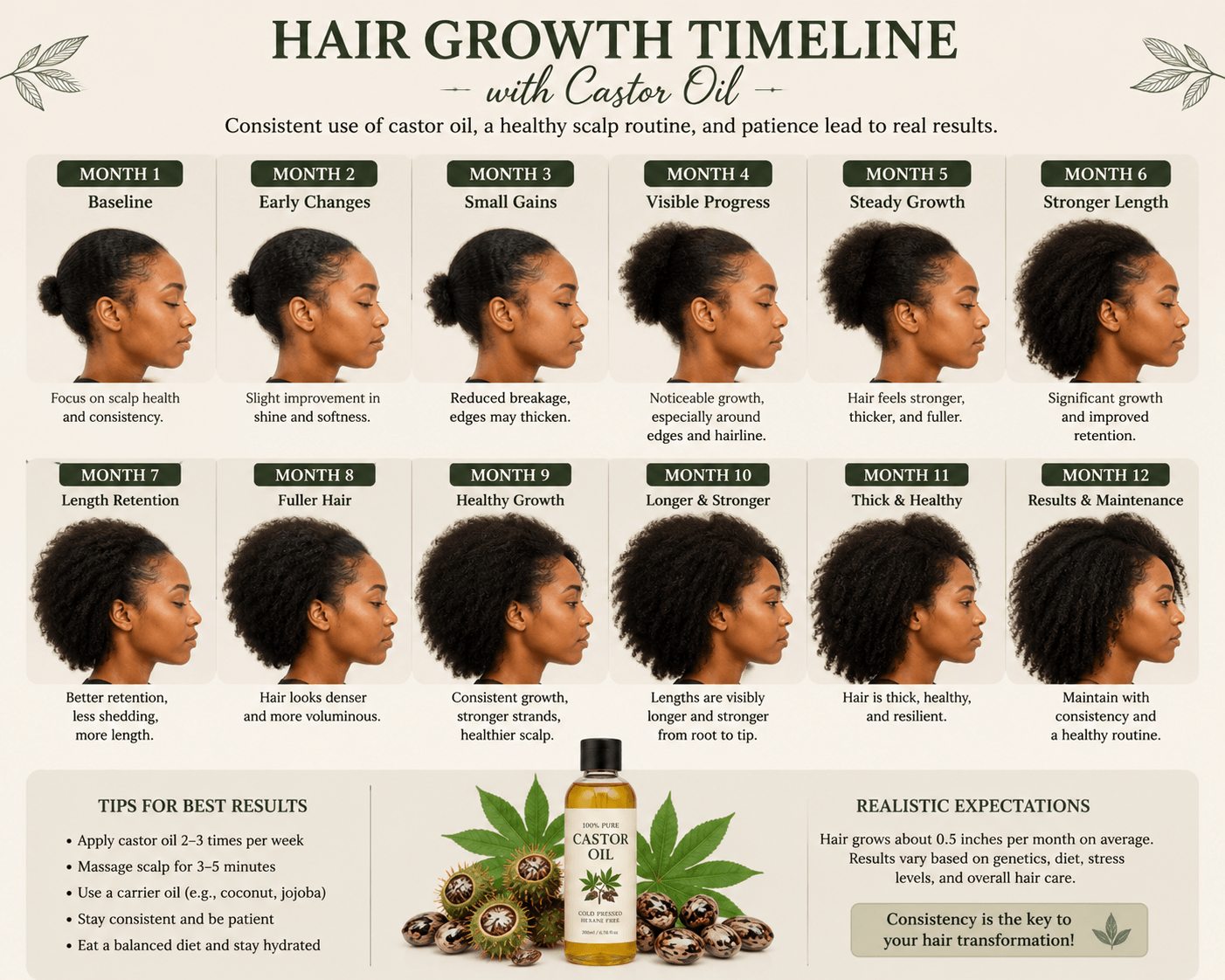
Setting realistic expectations is crucial for success. Here’s what you should honestly expect:
Weeks 1-2: Your scalp will feel more moisturized and less itchy. Additionally, any dandruff or flakiness should start reducing. Don’t expect visible growth at this stage.
Weeks 3-4: Breakage should noticeably reduce. Moreover, your hair will feel stronger and softer. You might see baby hairs appearing along your hairline, which is an encouraging sign.
Weeks 5-8: This is when most people see visible changes. Specifically, hair appears longer because breakage has significantly reduced. Furthermore, edges and thin areas may show new growth beginning.
Weeks 9-12: Significant improvements become visible. Your hair is measurably longer, fuller, and healthier. Additionally, your scalp health should be dramatically improved.
Beyond 12 weeks: Continued consistent improvement. However, this is maintenance territory now. Keep using castor oil to maintain the healthy scalp environment you’ve created.
Pro tip: Take photos every two weeks from the same angle. Day-to-day changes are invisible to the naked eye. Consequently, photos are the only reliable way to track real progress.
Common Mistakes People Make With Castor Oil
Mistake 1: Using too much More oil doesn’t mean better results. In fact, using too much causes buildup that actually blocks follicles. A little goes a long way with such a thick oil.
Mistake 2: Not massaging Simply applying oil without massaging is a wasted opportunity. The massage is responsible for much of the benefit. Therefore, always spend at least 5 minutes massaging after application.
Mistake 3: Not diluting it Pure castor oil is very thick and difficult to distribute evenly. Additionally, it’s hard to rinse out completely. Always mix it with lighter oils for better application and absorption.
Mistake 4: Inconsistent use Using castor oil once a week for two weeks then stopping won’t show results. Consequently, commit to at least 12 weeks of consistent use before making judgments.
Mistake 5: Expecting it to work alone Castor oil works best as part of a comprehensive hair care routine. Furthermore, protect your hair with satin bonnets, minimize heat, eat well, and stay hydrated.
Mistake 6: Buying poor quality oil Not all castor oil is created equal. Refined castor oil has lost many beneficial properties during processing. Therefore, always choose cold-pressed, unrefined castor oil from a reliable supplier.
So Does Castor Oil Really Work? The Honest Verdict
After everything we’ve covered, here’s my straightforward answer:
Yes, castor oil works. But not in the way most people think.
It won’t grow 4 inches in a month. It won’t restore a completely bald scalp. Moreover, it won’t deliver results without consistency and proper technique.
However, what castor oil genuinely does is:
- Create the healthiest possible scalp environment for growth
- Dramatically reduce breakage so you retain the length you grow
- Strengthen and protect your hair from damage
- Moisturize your scalp and reduce inflammation
- Support your overall hair health comprehensively
For Nigerian women dealing with slow growth, thin edges, breakage, and scalp issues, castor oil is genuinely one of the most useful natural ingredients available. Furthermore, when used correctly and consistently, the results are real and visible.
The key is realistic expectations combined with consistent application and proper technique.
Your Action Plan: Start Tonight
Now that you know the truth about castor oil, here’s exactly what to do:
First, get quality, cold-pressed castor oil from a reliable supplier. Quality matters more than most people realize.
Second, mix it with lighter oils to improve application (see the growth mix recipe above).
Third, commit to applying it 2-3 times per week for 12 weeks minimum.
Fourth, take photos every two weeks so you can actually see your progress.
Finally, be patient. Real hair growth takes time, but with consistency, the results are absolutely worth it.
Ready to start your castor oil journey? You’ll also need:
- Sweet Almond Oil – Perfect lightweight oil to mix with castor oil
- Coconut Oil – Penetrates hair shaft for deep strengthening
- Vegetable Glycerine – Add to your mix for extra moisture and slip
Have you tried castor oil for hair growth? What were your results? Drop your experience in the comments below. Your honest review might help someone else on their hair growth journey!