
Coconut Oil for Skin: The Complete Nigerian Guide
Coconut oil for skin has been a topic of conversation in Nigerian households long before the internet made it a global trend. Your grandmother probably used it. Your mother might have rubbed it on your skin as a baby. And now, beauty influencers worldwide are calling it a miracle ingredient.
But here’s what most guides won’t tell you: coconut oil is incredibly powerful for some skin types and completely wrong for others. Moreover, most people using it are either using the wrong type or applying it incorrectly, which means they’re not getting the full benefits it offers.
As Nigeria’s leading cosmetic raw materials supplier serving over 5,000 beauty entrepreneurs, we’ve worked with coconut oil extensively across countless formulations. Furthermore, we’ve seen firsthand what it does well, what it doesn’t do, and how to use it correctly for Nigerian skin specifically.
Today, I’m giving you the complete, honest guide to using coconut oil for skin. Additionally, I’ll cover exactly which skin types benefit most, which should avoid it entirely, and how to maximize its benefits when combined with other natural ingredients.
By the end, you’ll know everything you need to use coconut oil confidently and correctly.
What Makes Coconut Oil Special for Skin?
Before we discuss benefits and uses, let’s understand what makes coconut oil uniquely effective compared to other natural oils.
Coconut oil comes from the meat of mature coconuts and is produced abundantly across West Africa, Southeast Asia, and the Pacific. Consequently, it’s one of the most accessible and affordable natural oils available in Nigeria today.
What sets coconut oil apart from other oils is its unique fatty acid composition. Specifically, it contains approximately 50% lauric acid, a medium-chain fatty acid with remarkable properties that most other oils simply don’t have.
Here’s why lauric acid matters:
According to research published on PubMed, lauric acid has powerful antimicrobial properties that kill bacteria, viruses, and fungi on contact. Therefore, coconut oil doesn’t just moisturize your skin, it actively protects it from infections and breakouts simultaneously.
Additionally, coconut oil contains caprylic acid and capric acid, two other medium-chain fatty acids that contribute to its antimicrobial and skin-softening properties. Furthermore, it’s rich in vitamin E, which provides antioxidant protection against environmental damage and premature aging.
The penetration advantage:
Unlike many heavier oils that sit on top of skin, coconut oil has a relatively small molecular structure that allows it to penetrate the skin surface more effectively. As a result, it delivers moisture and nutrients deeper into the skin rather than just coating the surface.
7 Proven Benefits of Coconut Oil for Skin
Benefit 1: Deep Moisturization That Lasts
Coconut oil for skin is most famous for its exceptional moisturizing ability, and the evidence supports this reputation.
A clinical study published in the Journal of Cosmetic Science found that virgin coconut oil was as effective as mineral oil in treating dry skin. Moreover, it significantly improved skin hydration and reduced water loss through the skin barrier.
For Nigerian skin specifically, which faces constant challenges from harmattan dryness, air conditioning, and sun exposure, this long-lasting moisturization is particularly valuable. Furthermore, the lauric acid in coconut oil helps repair the skin’s natural moisture barrier, reducing water loss over time rather than just temporarily masking dryness.
Best for: Dry to very dry skin, particularly during harmattan season
Benefit 2: Powerful Antimicrobial Protection
This is where coconut oil truly stands apart from most other natural moisturizers.
Research cited by Healthline confirms that the lauric acid in coconut oil kills harmful microorganisms including Staphylococcus aureus (a common cause of skin infections) and Candida albicans (a fungal infection that causes skin rashes).
Consequently, applying coconut oil to your skin creates a protective antimicrobial barrier that reduces your risk of skin infections, particularly in humid Nigerian weather where bacterial and fungal issues are common. Furthermore, this property makes it valuable for treating minor cuts, scrapes, and skin irritations.
Best for: Infection-prone skin, minor wounds, fungal skin conditions
Benefit 3: Reduces Inflammation and Soothes Irritation
Many Nigerians deal with skin inflammation from various causes including heat rash, insect bites, eczema, and reactions to harsh products. Coconut oil addresses all of these effectively.
The fatty acids in coconut oil have demonstrated significant anti-inflammatory properties in multiple studies. As a result, applying coconut oil to inflamed or irritated skin can visibly reduce redness, swelling, and discomfort within hours.
Additionally, virgin coconut oil has been shown to be particularly effective for eczema. Specifically, a study found it significantly reduced eczema severity compared to mineral oil, making it a valuable natural alternative for those avoiding steroid creams.
Best for: Eczema, heat rash, insect bites, contact dermatitis
Benefit 4: Fades Dark Spots and Improves Skin Tone
This benefit is particularly relevant for Nigerian women dealing with hyperpigmentation, dark spots, and uneven skin tone.
Coconut oil contains vitamin E and ferulic acid, both of which have antioxidant properties that help fade dark spots over time. Moreover, its ability to deeply moisturize skin promotes faster cell turnover, which gradually replaces pigmented skin cells with fresh, more evenly toned ones.
Furthermore, when combined with natural brightening ingredients like lemon essential oil or turmeric, coconut oil becomes an effective carrier for these active ingredients, helping them penetrate more effectively into the skin.
Best for: Post-acne dark spots, uneven skin tone, gradual brightening
Benefit 5: Anti-Aging Benefits
Coconut oil for skin provides meaningful anti-aging benefits that many people overlook.
The vitamin E content in coconut oil neutralizes free radicals that cause premature aging. Additionally, its deep moisturization plumps skin and reduces the appearance of fine lines caused by dehydration. Furthermore, its ability to repair the skin barrier means skin retains moisture more effectively over time, maintaining that youthful, plump appearance.
Many Nigerian women in their 50s and 60s who have used coconut oil consistently throughout their lives report remarkably smooth, supple skin. While genetics plays a role, consistent moisturization with penetrating oils like coconut oil undoubtedly contributes.
Best for: Mature skin, early signs of aging, prevention
Benefit 6: Lip Care and Treatment
Your lips are covered with thinner skin than the rest of your body and have no oil glands of their own. Consequently, they’re extremely vulnerable to dryness, particularly during harmattan season.
Coconut oil is one of the most effective natural lip treatments available. It moisturizes deeply, provides a protective barrier against wind and sun, and its antimicrobial properties help heal cracked lips faster. Moreover, it’s completely safe to ingest, which is important given how much lip product we accidentally consume.
Best for: Dry, cracked lips, lip protection during harmattan
Benefit 7: Makeup Removal
This is a coconut oil benefit many people don’t know about, and it’s genuinely impressive.
Coconut oil dissolves makeup effectively, including waterproof mascara and long-wear foundation, without stripping your skin’s natural moisture. Furthermore, unlike commercial makeup removers that contain harsh chemicals and alcohol, coconut oil simultaneously moisturizes as it cleanses.
Apply a small amount to a cotton pad or your fingertips. Then, gently massage over your face to dissolve makeup. Finally, rinse with warm water and follow with your regular cleanser.
Best for: All skin types for makeup removal, particularly dry skin
How to Use Coconut Oil for Skin (Step-by-Step)
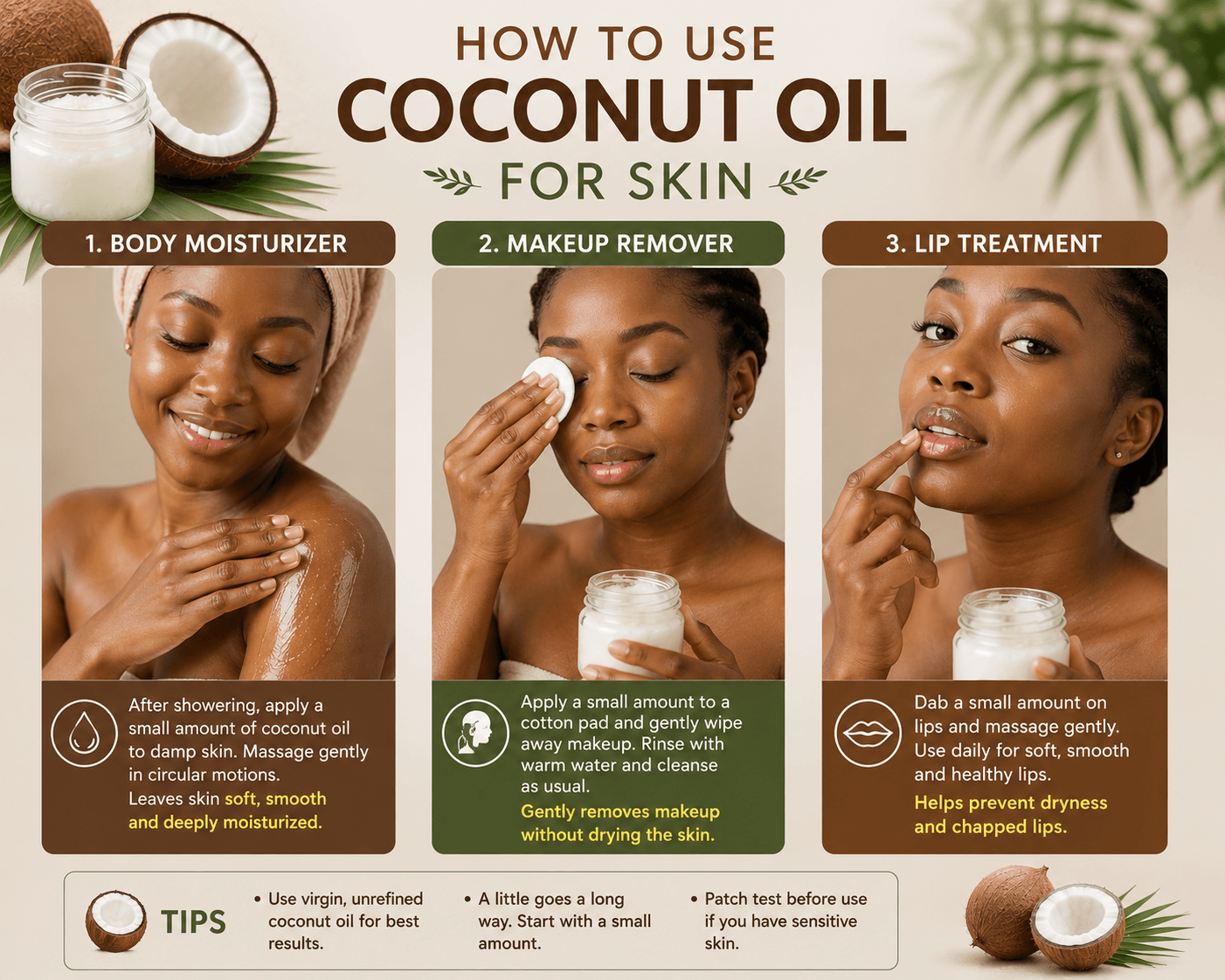
Knowing the benefits of coconut oil for skin is only useful if you’re applying it correctly. Here’s exactly how to use it for different purposes.
As a Daily Body Moisturizer
Step 1: After your shower, while your skin is still slightly damp, scoop a small amount of coconut oil (about a teaspoon for your entire body) into your palm.
Step 2: Rub your palms together to melt the oil (body heat is enough).
Step 3: Apply to your skin in smooth, circular motions, working from your feet upward.
Step 4: Pay extra attention to dry areas including elbows, knees, heels, and ankles.
Pro tip: Less is more with coconut oil. A thin layer absorbs beautifully. However, too much leaves a greasy residue that transfers to clothing.
As a Facial Moisturizer (For Suitable Skin Types)
Step 1: Cleanse your face thoroughly first.
Step 2: Apply a very small amount (just a pea-sized drop) to your fingertips.
Step 3: Warm between fingers and press gently onto your face rather than rubbing.
Step 4: Leave on overnight for maximum benefit.
Important: Only use coconut oil on your face if you have dry or normal skin. Furthermore, avoid using it as a daily facial moisturizer if you’re acne-prone (more on this below).
As a Deep Conditioning Hair Treatment
Step 1: Warm coconut oil slightly by placing the container in warm water.
Step 2: Apply generously to your hair from roots to ends.
Step 3: Cover with a shower cap and leave for 30 minutes to overnight.
Step 4: Wash out thoroughly with shampoo (you may need to shampoo twice).
Frequency: Once per week as a pre-wash treatment.
As a Natural Makeup Remover
Step 1: Scoop a small amount of coconut oil onto clean fingertips.
Step 2: Gently massage over your closed eyes and face in circular motions.
Step 3: Watch as makeup dissolves effortlessly, even waterproof products.
Step 4: Wipe away with a warm, damp cloth. Follow with your regular cleanser.
As a Lip Treatment
Step 1: Apply a tiny amount of coconut oil to your lips before bed.
Step 2: Gently press lips together to distribute evenly.
Step 3: Leave overnight. Wake up to noticeably softer lips.
Frequency: Nightly during harmattan, or whenever lips feel dry.
Coconut Oil for Different Skin Types
This section is crucial because coconut oil for skin doesn’t work equally well for everyone. Understanding your skin type prevents frustration and potential breakouts.
Dry Skin (Best Match)
Dry skin benefits enormously from coconut oil. The deep moisturization, barrier repair, and long-lasting hydration address everything dry skin needs. Consequently, this is the skin type that sees the most dramatic improvement with coconut oil use.
Recommended use: Daily body moisturizer, nightly facial treatment, weekly hair treatment.
Normal Skin (Great Match)
Normal skin responds well to coconut oil in most applications. Furthermore, you have the flexibility to use it on both face and body without significant risk of breakouts.
Recommended use: Daily body moisturizer, 2-3 times weekly facial use, lip treatment.
Sensitive Skin (Good Match with Caution)
Sensitive skin can generally tolerate coconut oil well because it’s natural and free from synthetic fragrances and chemicals. However, always patch test first by applying a small amount to your inner wrist and waiting 24 hours before full application.
Recommended use: Body moisturizer, avoid face initially, patch test everything.
Oily Skin (Use Carefully)
Here’s where honesty is important. Coconut oil is comedogenic (meaning it can clog pores) with a comedogenic rating of 4 out of 5. Therefore, it’s not recommended for facial use on oily or acne-prone skin.
However, it can still be used on the body where pores are larger and less prone to clogging. Additionally, it works well as a makeup remover even for oily skin, as long as you follow immediately with a proper cleanser.
Recommended use: Body only, makeup remover (followed by cleanser), avoid face entirely.
Acne-Prone Skin (Avoid on Face)
This is the most important warning in this entire guide. Coconut oil’s high comedogenic rating means it’s very likely to clog pores and trigger breakouts on acne-prone facial skin.
If you have acne-prone skin, avoid using coconut oil on your face entirely. Instead, opt for lighter, non-comedogenic oils like Sweet Almond Oil or jojoba oil for facial moisturization.
Recommended use: Body moisturizer only, hair treatment, lip care.
What Coconut Oil CANNOT Do (The Honest Part)
Being honest about limitations builds more trust than overpromising results.
It cannot treat severe acne. While its antimicrobial properties help prevent bacterial growth, coconut oil’s pore-clogging tendency makes it counterproductive for acne-prone skin. Therefore, use dedicated acne treatments instead.
It cannot provide adequate sun protection. Some sources claim coconut oil has SPF 4-8. However, this is far too low to provide meaningful sun protection. Never use coconut oil as a sunscreen replacement. Always use a proper broad-spectrum SPF 30+ sunscreen.
It cannot reverse serious skin conditions. While coconut oil helps with mild eczema and dryness, serious skin conditions require proper medical treatment. Consequently, see a dermatologist for persistent or severe skin issues.
It cannot dramatically fade deep hyperpigmentation quickly. Coconut oil contributes to gradual brightening over time, but it’s not a fast-acting treatment for dark spots. For faster results, combine it with dedicated brightening actives like Alpha Arbutin or Niacinamide.
It cannot work the same for everyone. Skin responses vary significantly. Furthermore, what works brilliantly for one person may cause breakouts for another. Always test before committing fully.
Best Combinations: Coconut Oil with Other Natural Ingredients
Coconut oil for skin becomes even more powerful when paired strategically with other natural ingredients you already know.
Coconut Oil + Shea Butter (Ultimate Moisture Combination)
Mix equal parts melted coconut oil and Natural Shea Butter for an intensely moisturizing body butter. The coconut oil provides fast absorption and antimicrobial benefits. Meanwhile, the shea butter adds vitamins A and E plus deep, long-lasting moisture. Together, they create a moisture combination greater than either ingredient alone.
Best for: Very dry skin, harmattan season, body use
Coconut Oil + Vegetable Glycerine (Lightweight Moisture)
Combine 70% coconut oil with 30% Vegetable Glycerine for a lighter, more easily absorbed moisturizer. The glycerine attracts moisture from the air to your skin. Additionally, it reduces the greasiness that some people experience with pure coconut oil. Furthermore, this combination works better for those who find pure coconut oil too heavy.
Best for: Normal to slightly oily skin, daytime use, humid weather
Coconut Oil + Sweet Almond Oil (Balanced Formula)
Mix equal parts coconut oil and Sweet Almond Oil for a beautifully balanced body oil. The sweet almond oil lightens coconut oil’s texture and adds vitamin E. Consequently, you get coconut oil’s antimicrobial benefits without the heaviness. Moreover, this combination absorbs faster and feels less greasy than pure coconut oil.
Best for: All skin types for body use, massage oil, daily moisturizer
Coconut Oil + Turmeric (Brightening Treatment)
Mix coconut oil with a pinch of turmeric powder to create a natural brightening treatment. Apply to dark spots, leave for 15-20 minutes, then rinse. The coconut oil carries the turmeric’s curcumin deeper into skin. Additionally, both ingredients have anti-inflammatory properties that work synergistically.
Best for: Dark spots, uneven skin tone, weekly treatment mask
Common Mistakes People Make With Coconut Oil
Mistake 1: Using refined coconut oil instead of virgin
Refined coconut oil has been processed with heat and chemicals, stripping many beneficial properties. Therefore, always choose virgin or extra-virgin, cold-pressed coconut oil for skin use.
Mistake 2: Using too much
A little coconut oil goes a long way. Using too much leaves skin greasy and can clog pores even on non-acne-prone skin. Start with a small amount and add more only if needed.
Mistake 3: Using it on acne-prone facial skin
As discussed, coconut oil’s high comedogenic rating makes it likely to cause breakouts on acne-prone faces. This is the most common coconut oil mistake Nigerian women make.
Mistake 4: Using it as sunscreen
Its natural SPF is too low to provide meaningful sun protection. Always use a dedicated SPF 30+ sunscreen separately.
Mistake 5: Not patch testing first
Even natural ingredients can cause reactions in some people. Therefore, always patch test on your inner wrist before applying to your face or body.
Mistake 6: Storing it incorrectly
Coconut oil melts at around 24°C, which means it liquefies easily in Nigerian heat. This is completely normal and doesn’t affect quality. However, store away from direct sunlight to prevent rancidity.
How to Choose Quality Coconut Oil
Not all coconut oil is created equal. Here’s what to look for when buying.
Virgin or Extra-Virgin: This means minimal processing and maximum nutrient retention. Consequently, you get the full benefits of lauric acid, vitamin E, and other beneficial compounds.
Cold-Pressed: This extraction method uses no heat. Therefore, heat-sensitive nutrients remain intact rather than being destroyed during processing.
Unrefined: Unrefined coconut oil retains its natural scent and color (white when solid, clear when liquid). Refined coconut oil is odorless and colorless but has fewer beneficial properties.
Certified Organic: If budget allows, organic coconut oil ensures no pesticides or chemicals were used during growing and processing.
Smell test: Quality virgin coconut oil smells like fresh coconut. If it smells rancid, chemical, or has no scent at all, it may be low quality or heavily refined.
Your Action Plan: Start Using Coconut Oil Correctly Tonight
You now have the complete guide to using coconut oil for skin the right way. Here’s exactly what to do based on your skin type.
If you have dry skin: Start using coconut oil as your daily body moisturizer tonight. Apply on slightly damp skin after your shower for maximum absorption.
If you have normal skin: Try coconut oil as your nightly facial moisturizer this week. Use a pea-sized amount and see how your skin responds over 7 days.
If you have oily or acne-prone skin: Use coconut oil for body moisturization and as a makeup remover only. For your face, choose lighter non-comedogenic alternatives instead.
If you have sensitive skin: Patch test on your inner wrist tonight. Wait 24 hours. If no reaction occurs, introduce it gradually into your routine.
This week’s action steps:
First, identify your skin type honestly. Second, choose the appropriate application method from this guide. Third, start with a small amount and observe how your skin responds. Fourth, combine with complementary ingredients for enhanced benefits. Finally, be consistent for at least 4 weeks before evaluating results.
Ready to start? Get your quality ingredients:
- Coconut Oil – Virgin, cold-pressed, perfect for skin and hair
- Natural Shea Butter – Perfect partner for coconut oil body butter
- Sweet Almond Oil – Lighter alternative for balanced body oil blend
- Vegetable Glycerine – Mix with coconut oil for lightweight daily moisturizer
Have you been using coconut oil for skin already? What results have you noticed? Share your experience in the comments below. Your story might help someone else get the most from this amazing natural ingredient!