
How to Make Natural Face Cream at Home (For African Skin)
You’ve switched to natural face wash. You’ve started using toner. But then you reach for that imported face cream that costs ₦5,000, ₦8,000, sometimes ₦15,000 for a tiny jar. Meanwhile, it contains the same basic ingredients you can source locally for a fraction of the price.
Here’s what the big skincare brands don’t want Nigerian women to know: the most effective face cream for African skin isn’t imported from Europe or America. It’s made from ingredients that have nourished African skin for generations, combined with modern actives that actually address our specific concerns.
As Nigeria’s leading cosmetic raw materials supplier at Sophix Natural, we’ve helped hundreds of beauty entrepreneurs create professional face cream formulations that compete with imported brands. Furthermore, we’ve watched Nigerian women with persistent dark spots, dry skin, and uneven tone transform their complexion simply by switching to a properly formulated natural face cream.
Today, I’m sharing three complete natural face cream recipes specifically formulated for African skin. Additionally, I’ll cover exactly which ingredients work best for our unique concerns, how to use each recipe correctly, and how to build a highly profitable facial skincare business.
Let’s get into it.
Why African Skin Needs a Different Face Cream
Before jumping into the natural face cream recipes, let’s understand why most commercial face creams fail Nigerian skin.
The majority of commercial face creams are formulated with European or American skin in mind. Specifically, these formulations prioritize anti-aging and sun protection concerns most relevant to lighter skin tones. Consequently, they often neglect the concerns most prevalent in African skin: hyperpigmentation, uneven tone, moisture retention in both humid and dry climates, and the specific needs of melanin-rich skin.
Additionally, many commercial face creams contain ingredients that actively worsen common Nigerian skin concerns. Specifically, silicones clog pores and trap melanin-stimulating inflammation underneath. Synthetic fragrances trigger the irritation that leads to post-inflammatory hyperpigmentation. Furthermore, many “brightening” creams contain mercury or hydroquinone at unsafe concentrations that cause long-term skin damage.
According to research published on PubMed, melanin-rich skin has unique structural and functional characteristics that require specifically tailored skincare formulations. Therefore, using products designed for different skin types produces suboptimal results at best and active harm at worst.
The solution is a face cream that addresses what African skin actually needs: deep hydration, gentle brightening, barrier support, and anti-inflammatory protection.
What Makes a Great Natural Face Cream for African Skin
Understanding the components of effective natural face cream formulation helps you create products that work professionally and target our specific skin concerns.
The Emollient Base (What Makes It Creamy)
Emollients are the oils and butters that give face cream its rich, moisturizing texture. However, for facial use, lighter emollients that won’t clog pores are essential.
Best facial emollients for African skin:
Shea butter (small amounts): Provides vitamins A and E plus deep moisture. Specifically, unrefined shea butter contains cinnamic acid that provides mild UV protection. However, use at lower concentrations on the face (5-10%) than in body products to avoid heaviness.
Sweet almond oil: Lightweight, non-comedogenic, and rich in vitamin E. Consequently, it moisturizes without clogging pores. Additionally, its mild exfoliating properties help fade dark spots gradually.
Jojoba oil: Mimics skin’s natural sebum, making it perfect for all skin types including oily and acne-prone. Furthermore, it regulates oil production and absorbs beautifully without residue.
The Water Phase (What Hydrates)
Face cream is an emulsion requiring a water phase. This is where water-soluble active ingredients go.
Distilled water: Your base. Using distilled or de-ionized water prevents minerals from interfering with your formula.
Aloe vera juice: Adds soothing, anti-inflammatory benefits. Additionally, its natural humectant properties boost the cream’s hydrating power.
Vegetable glycerine: The essential humectant that attracts moisture from the environment to skin throughout the day.
The Emulsifier (What Holds It Together)
Without an emulsifier, your oil and water phases will separate immediately. Specifically, for face cream you need an emulsifier that creates a stable, elegant texture without leaving residue.
Emulsifying Wax NF or BTMS-25: Both work well for facial emulsions. BTMS-25 is slightly more conditioning and creates a silkier texture. Consequently, it’s preferred for premium face cream formulations.
The Active Ingredients (What Treats Skin)
This is what separates a basic moisturizer from a treatment cream. Different actives target different African skin concerns.
For brightening: Niacinamide (5%), Alpha Arbutin (2%), Kojic Acid (1%)
For anti-aging: Retinol (0.1-0.3%), Vitamin C (10%), Peptides
For acne: Niacinamide (5%), Azelaic Acid (10%)
For hydration: Hyaluronic Acid (1%), Glycerine (3-5%)
What You’ll Need
Basic Ingredients for All Recipes:
Oil Phase:
- Natural Shea Butter – Vitamins and deep moisture
- Sweet Almond Oil – Lightweight facial emollient
- Emulsifying Wax NF or BTMS-25 – Emulsifier
- Cetyl Alcohol – Thickener and emollient
Water Phase:
- Distilled water – Base
- Aloe Vera Juice – Soothing hydrator
- Vegetable Glycerine – Humectant
Cool Down Phase:
- Preservative (Germall Plus)
- Active ingredients (recipe-specific)
- Essential oils
- Citric acid (pH adjustment)
Equipment:
- Digital kitchen scale
- Double boiler setup
- Hand mixer or stick blender
- Thermometer
- pH strips or digital meter
- Clean glass jars or pump bottles
- Labels
- 70% isopropyl alcohol
Total cost: Approximately ₦2,500-₦3,500 to make 100ml of premium natural face cream
Compare that to ₦5,000-₦15,000 for imported face creams of similar quality!
Recipe 1: Natural Face Cream Basic Hydrating Formula (All Skin Types)
This is your foundation recipe. It’s a beautifully balanced, lightweight face cream that moisturizes deeply without feeling heavy or greasy. Furthermore, it’s suitable for all skin types including combination and slightly oily skin when used in appropriate amounts.
Makes: 100ml
Ingredients by Weight:
Oil Phase (heat to 70-75°C):
- Emulsifying Wax NF – 6g (6%)
- Cetyl Alcohol – 2g (2%)
- Natural Shea Butter – 5g (5%)
- Sweet Almond Oil – 8g (8%)
Water Phase (heat to 70-75°C):
- Distilled water – 68g (68%)
- Aloe Vera Juice – 5g (5%)
- Vegetable Glycerine – 3g (3%)
Cool Down Phase (add at 40°C):
- Preservative (Germall Plus) – 0.5g (0.5%)
- Vitamin E Oil – 0.5g (0.5%)
- Essential oils – 5 drops
- Citric acid (pH adjustment)
Total: 100g
Cost breakdown: Approximately ₦1,800-₦2,200 for 100ml
Step-by-Step Instructions:
Step 1: Natural Face Cream Preparation (Sanitize Equipment)
Sanitize every piece of equipment with 70% isopropyl alcohol. Allow to air dry completely. This step is critical because face cream has a higher risk of contamination than rinse-off products. Furthermore, measure and weigh all ingredients before starting.
Step 2: Heat Both Phases Separately (10 minutes)
Place oil phase ingredients (emulsifying wax, cetyl alcohol, shea butter, sweet almond oil) in one heat-safe bowl. Place water phase ingredients (distilled water, aloe vera juice, glycerine) in a separate heat-safe bowl.
Heat both bowls simultaneously in a double boiler to 70-75°C. Stir occasionally. Both phases must reach the same temperature before combining. Consequently, this temperature match ensures proper emulsion formation.
What you’ll see: The oil phase melts into a clear, slightly golden liquid. Meanwhile, the water phase remains clear but warm.
Step 3: Combine Phases (3 minutes)
Once both phases reach 70-75°C, slowly pour the water phase INTO the oil phase while mixing continuously with a hand mixer on low speed.
Important technique: Pour water into oil slowly and steadily. Keep mixing continuously throughout. You’ll immediately see the mixture turn white and creamy as the emulsion forms. Continue mixing for 3-5 minutes until fully combined and uniform.
Step 4: Mix While Cooling (15-20 minutes)
Keep mixing occasionally as the cream cools. Stir every 2-3 minutes. The cream will thicken significantly as it cools from liquid to cream consistency.
What proper cooling looks like: At 60°C it’s still quite liquid. By 50°C it starts thickening noticeably. By 40°C it should be close to final cream consistency.
Step 5: Add Cool Down Ingredients at 40°C
Once the temperature drops to 40°C or below, add your preservative, vitamin E, and essential oils. Stir gently but thoroughly.
Best essential oils for African facial skin:
Frankincense (3 drops) – anti-aging, skin tone evening, deeply restorative
Lavender (3 drops) – calming, suitable for all skin types, reduces inflammation
Rose (2 drops) – hydrating, brightening, luxurious scent that customers love
Geranium (2 drops) – balances oil production, good for combination skin
Avoid all citrus oils in face cream because they can cause photosensitivity and trigger dark spots on African skin.
Step 6: Test and Adjust pH (5 minutes)
Test pH carefully. Natural face cream should have a pH of 5.0-6.0, matching facial skin’s natural pH. According to the International Journal of Cosmetic Science, maintaining correct facial product pH is essential for preventing barrier disruption, acne, and accelerated aging.
If pH is above 6.0: Add citric acid solution drop by drop. Stir and retest.
If pH is below 5.0: Add tiny amount of baking soda dissolved in water. Stir and retest.
Step 7: Package and Label (5 minutes)
Transfer to clean, sanitized glass jars or pump bottles. Glass jars are preferred for face cream because they’re more hygienic and look premium. Additionally, airless pump bottles are excellent because they prevent oxidation of active ingredients.
Shelf life: 3-6 months with proper preservation and clean usage habits.
Total making time: 35-40 minutes
Recipe 2: Natural Face Cream Brightening Formula (For Dark Spots and Hyperpigmentation)
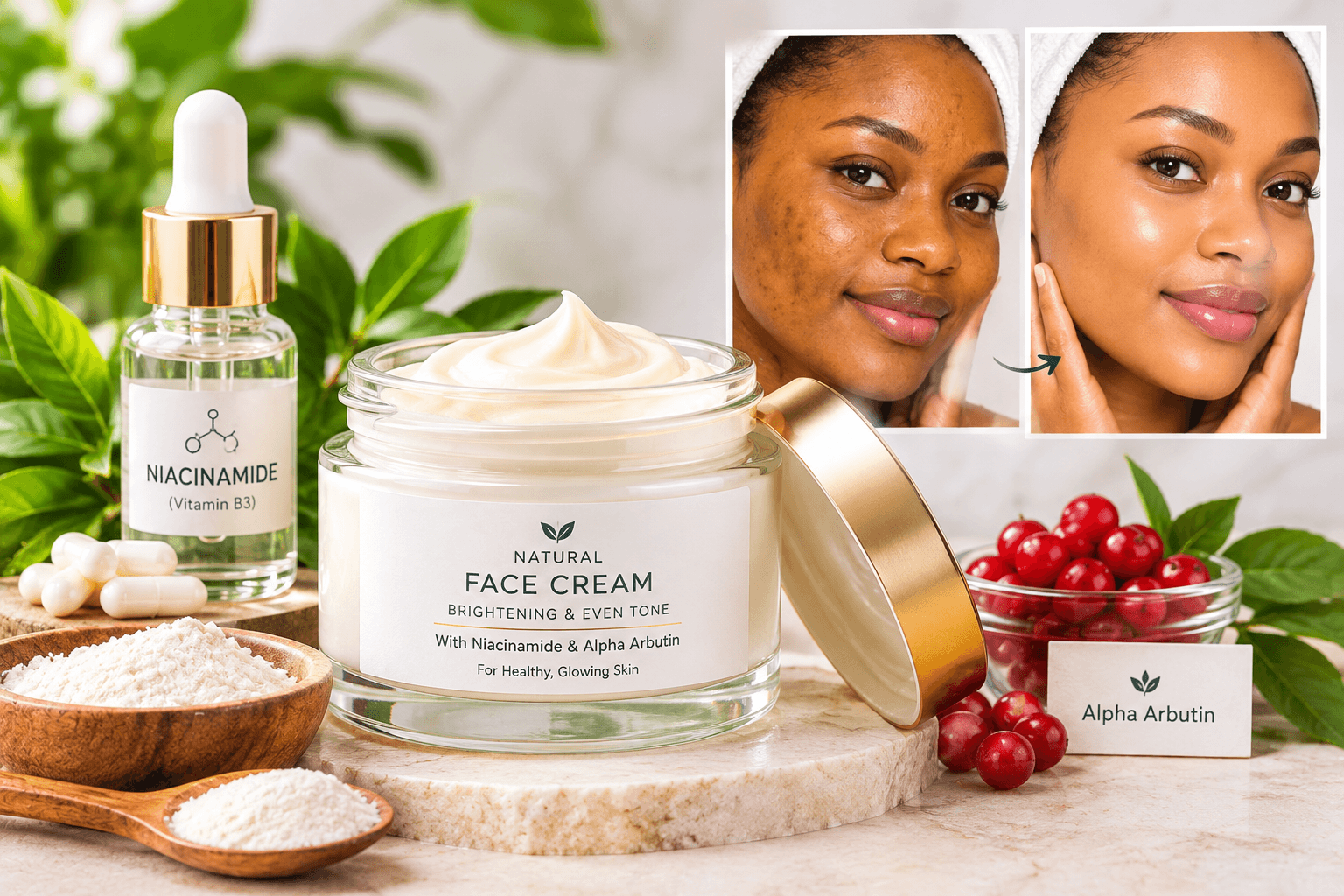
This recipe is specifically designed for the hyperpigmentation and uneven skin tone concerns that affect the majority of Nigerian women. Furthermore, it combines multiple proven brightening actives for comprehensive, faster results than any single ingredient alone.
Makes: 100ml
Ingredients by Weight:
Oil Phase (heat to 70-75°C):
- Emulsifying Wax NF – 6g (6%)
- Cetyl Alcohol – 2g (2%)
- Natural Shea Butter – 4g (4%)
- Sweet Almond Oil – 7g (7%)
Water Phase (heat to 70-75°C):
- Distilled water – 60g (60%)
- Aloe Vera Juice – 8g (8%)
- Vegetable Glycerine – 3g (3%)
- Niacinamide – 5g (5%)
Cool Down Phase (add at 40°C):
- Alpha Arbutin – 2g (2%)
- Preservative – 0.5g (0.5%)
- Vitamin E Oil – 0.5g (0.5%)
- Frankincense Essential Oil – 3 drops
- Lavender Essential Oil – 2 drops
- Citric acid (pH adjustment)
Total: 100g
What Makes This Recipe Powerful for African Skin:
Niacinamide at 5% is the first star ingredient. Specifically, it inhibits melanin transfer from pigment-producing cells to skin surface cells. Consequently, existing dark spots fade gradually and new ones form more slowly with consistent use. Additionally, niacinamide strengthens the skin barrier, minimizes pores, and reduces inflammation that triggers hyperpigmentation.
Alpha Arbutin at 2% is the second star ingredient. It inhibits tyrosinase, the enzyme responsible for melanin production. Furthermore, it’s one of the safest brightening actives available, making it ideal for daily use on African skin. Research confirms it significantly reduces melanin synthesis within 4-8 weeks of consistent use.
Together, these two ingredients attack hyperpigmentation from two different angles simultaneously. Consequently, results are significantly faster than using either ingredient alone.
Special Instructions for Recipe 2:
Add niacinamide to the water phase before heating. It dissolves easily and is heat-stable, so it can be heated with the water phase without damage. Stir until completely dissolved.
Add Alpha Arbutin in the cool down phase at 40°C or below. Specifically, Alpha Arbutin is sensitive to high temperatures that can degrade its effectiveness. Therefore, adding it cool ensures maximum potency in your finished cream.
Everything else follows exactly the same steps as Recipe 1.
pH adjustment note: Both niacinamide and Alpha Arbutin work best at pH 5.5-6.5. Therefore, aim for pH 5.5-6.0 in this recipe specifically.
Expected Results Timeline:
Weeks 1-2: Skin feels more hydrated and comfortable. Additionally, overall radiance improves noticeably.
Weeks 3-4: Edges of dark spots begin to lighten. Furthermore, new spots from recent breakouts fade significantly faster.
Weeks 6-8: Visible improvement in overall skin tone evenness. Consequently, skin appears brighter and more radiant without makeup.
Weeks 10-12: Significant dark spot reduction. Moreover, skin texture is visibly smoother and more refined from the combined action of all actives.
Recipe 3: Natural Face Cream Anti-Aging Formula (For Mature Nigerian Skin)
This recipe is designed for women in their 30s, 40s, and beyond who are dealing with the early signs of aging specific to African skin. Furthermore, it addresses the unique way aging manifests in melanin-rich skin.
Makes: 100ml
Ingredients by Weight:
Oil Phase (heat to 70-75°C):
- Emulsifying Wax NF – 6g (6%)
- Cetyl Alcohol – 3g (3%)
- Natural Shea Butter – 7g (7%)
- Sweet Almond Oil – 8g (8%)
- Vitamin E Oil – 1g (1%)
Water Phase (heat to 70-75°C):
- Distilled water – 58g (58%)
- Aloe Vera Juice – 8g (8%)
- Vegetable Glycerine – 5g (5%)
- Niacinamide – 3g (3%)
Cool Down Phase (add at 40°C):
- Preservative – 0.5g (0.5%)
- Frankincense Essential Oil – 4 drops
- Rose Essential Oil – 3 drops
- Citric acid (pH adjustment)
Total: 100g
What Makes This Formula Specifically Anti-Aging for African Skin:
Higher shea butter content (7%) provides increased vitamin A and E delivery. Specifically, vitamin A promotes cell turnover, replacing older, duller cells with fresh ones. Consequently, skin looks younger and more radiant with consistent use.
Higher glycerine (5%) provides maximum humectant hydration. As skin ages, it naturally loses its ability to retain moisture. Therefore, a higher humectant concentration compensates for this reduced capacity.
Increased vitamin E in both oil and cool down phases provides maximum antioxidant protection. Specifically, free radicals are a primary driver of skin aging. Consequently, generous vitamin E content fights this process continuously.
Frankincense essential oil has been shown in research to promote cellular regeneration and improve skin firmness. Additionally, it has well-documented anti-inflammatory properties that reduce the chronic low-grade inflammation that accelerates aging.
Instructions:
Follow exactly the same steps as Recipe 1. The richer oil phase will create a slightly thicker, more luxurious cream texture. Consequently, this recipe is best suited for dry to normal mature skin rather than oily skin types.
Natural Face Cream for Different Nigerian Skin Types
For Dry Facial Skin
Dry skin needs maximum moisture delivery and barrier support. Therefore, use Recipe 1 as your base and increase shea butter to 8g and sweet almond oil to 10g. Additionally, increase glycerine to 5g. Furthermore, use morning and evening consistently for cumulative hydration benefits.
Application tip: Apply to slightly damp skin immediately after toning. The damp skin surface helps the cream absorb more effectively and delivers deeper hydration. Specifically, press the cream gently into skin rather than rubbing aggressively.
For Oily and Acne-Prone Skin
Oily skin needs lightweight hydration without pore-clogging ingredients. Therefore, use Recipe 1 but reduce shea butter to 2g and increase sweet almond oil to 12g. Additionally, add 3g of niacinamide to the water phase for sebum regulation. Consequently, skin stays hydrated without feeling greasy.
Application tip: Use the smallest possible amount (a pea-sized portion for your entire face). Apply only in the evening and let your natural oils moisturize during the day. Furthermore, skip the cream on very oily days and use glycerine diluted with water instead.
For Combination Skin
Combination skin needs a balanced approach that addresses different zones differently. Consequently, use Recipe 1 as formulated without modifications. Apply a slightly thicker layer on dry areas (cheeks, temples) and a thinner layer on oily areas (T-zone).
For Sensitive Skin
Sensitive skin needs the gentlest possible formula with minimal active ingredients. Therefore, use Recipe 1 but eliminate essential oils entirely and replace with 2 drops of chamomile extract if available. Additionally, patch test on your inner wrist for 48 hours before applying to your face.
Application tip: Introduce the cream gradually. Start with every other evening for the first week, then increase to nightly use. Furthermore, if any redness or irritation develops, reduce frequency and check ingredient compatibility.
For Hyperpigmented Skin
Use Recipe 2 (brightening formula) consistently morning and evening. Additionally, always follow with SPF 30+ sunscreen in the morning because brightening actives increase photosensitivity slightly. Furthermore, be patient because meaningful hyperpigmentation reduction takes 8-12 weeks minimum.
How to Use Natural Face Cream Correctly
Getting the application right determines whether you see results or just waste good product.
Complete Daily Skincare Routine for African Skin:
Morning:
Step 1: Cleanse with your natural face wash. Pat dry gently.
Step 2: Apply toner or rose water to damp skin. Allow to absorb for 30 seconds.
Step 3: Apply any serums (vitamin C, hyaluronic acid) before your cream.
Step 4: Apply your natural face cream. Specifically, use a pea-sized amount for your entire face. Warm between fingertips and press gently onto skin rather than rubbing.
Step 5: Apply sunscreen immediately after. This step is non-negotiable for African skin because UV exposure directly stimulates melanin production and worsens hyperpigmentation.
Evening:
Step 1: Double cleanse to remove sunscreen and daily buildup.
Step 2: Apply toner.
Step 3: Apply treatment serums (niacinamide, retinol if using).
Step 4: Apply a slightly larger amount of face cream than morning. The evening is when skin repairs itself. Consequently, more cream during this period maximizes overnight repair.
How Much to Use:
A pea-sized amount is genuinely sufficient for your entire face. Using more doesn’t improve results. Furthermore, using too much can actually clog pores and cause breakouts, particularly on oily or combination skin types.
How to Apply:
Warm the cream between your fingertips for 3-5 seconds before applying. This melts the cream slightly and helps it absorb more evenly. Then, press (don’t rub) onto skin starting from the center of your face outward. Specifically, use upward motions on the neck to counteract gravity over time.
Troubleshooting Your Natural Face Cream
Problem: Cream separated into water and oil layers
Why: Emulsion broke during cooling, emulsifying wax percentage too low, or phases weren’t at matching temperatures when combined.
Fix: Reheat to 70°C, mix vigorously for 5 minutes with hand mixer, and cool slowly while stirring continuously. Additionally, increase emulsifying wax by 1g in future batches.
Problem: Cream is too thick and hard to spread
Why: Too much butter or cetyl alcohol, or insufficient water.
Fix: Add distilled water 2g at a time while warming and mixing gently. Furthermore, reduce cetyl alcohol by 1g in future batches.
Problem: Cream feels greasy on skin
Why: Oil percentage is too high or skin type isn’t compatible with the current formula.
Fix: Reduce shea butter and sweet almond oil and replace with more water. Additionally, switch to lighter oils like jojoba in future batches for oily skin types.
Problem: Cream is causing breakouts
Why: Pore-clogging ingredients, incorrect pH, or a specific ingredient incompatibility.
Fix: Test and correct pH to 5.0-6.0. Additionally, reduce shea butter to 2-3% and increase jojoba oil instead. Furthermore, patch test each ingredient individually to identify the specific cause.
Problem: Active ingredients (niacinamide, Alpha Arbutin) aren’t showing results after 8 weeks
Why: Concentration too low, pH incorrect for actives, or sun exposure is undoing progress.
Fix: Verify concentrations in your formula. Check pH is in the correct range for your actives. Most importantly, ensure you’re using broad-spectrum SPF 30+ sunscreen every single morning. Without sunscreen, brightening actives cannot overcome the continuous melanin stimulation from UV exposure.
Problem: Cream has changed color or smells different after 3 weeks
Why: Insufficient preservative, contaminated packaging, or oxidation of sensitive ingredients.
Fix: Always sanitize jars before filling. Use a spatula rather than fingers to scoop product. Additionally, store in a cool, dark place away from humidity and heat.
Packaging and Selling Your Natural Face Cream
Natural face cream is the highest-value product in any Nigerian skincare brand’s lineup. Here’s how to maximize your commercial success.
Container Options:
Glass jars (30-50ml): Most premium appearance and easiest to fill. Customers love the luxurious feel of glass. Consequently, these command the highest retail prices and make excellent product photos.
Airless pump bottles (30-50ml): Most hygienic option because they minimize air exposure that degrades active ingredients. Furthermore, they appeal to sophisticated customers who understand ingredient stability.
Frosted glass jars: Combines the premium feel of glass with UV protection that extends shelf life of light-sensitive actives like vitamin C.
Labeling Your Natural Face Cream:
Essential label information:
- Product name and skin type suitability
- Full INCI ingredient list in descending order
- Net weight in grams
- Manufacturing date and batch number
- “For external use only”
- pH level (customers love seeing this – builds credibility)
- Active ingredient claims (“With 5% Niacinamide”, “With Alpha Arbutin”)
- Your brand contact information
Power claims that sell:
- “Formulated for African skin”
- “5% Niacinamide for dark spot fading” (Recipe 2)
- “Silicone-free and paraben-free”
- “pH-balanced for Nigerian climate”
- “No harmful bleaching agents”
Pricing Your Natural Face Cream:
Cost breakdown per 50ml jar:
- Ingredients: ₦1,200-₦1,800
- Glass jar and label: ₦500-₦800
- Total cost: ₦1,700-₦2,600
Recommended retail prices:
- Basic hydrating formula: ₦4,500-₦6,000 per 50ml
- Brightening formula with niacinamide + arbutin: ₦6,000-₦9,000 per 50ml
- Anti-aging formula: ₦7,000-₦10,000 per 50ml
Profit per jar: ₦2,000-₦7,400 depending on recipe and positioning
Scale example: Sell 20 brightening formula jars monthly at ₦8,000 each = ₦160,000 revenue, approximately ₦120,000 profit. That’s exceptional income for a premium product that takes under an hour to make per batch!
Why Face Cream Commands Premium Prices:
Customers are psychologically prepared to pay more for facial products than body products. Specifically, Nigerian women already spend ₦5,000-₦15,000 on imported face creams regularly. Consequently, a locally-made, natural alternative with clear active ingredient labeling and professional packaging can legitimately compete at this price point.
Additionally, the natural and “no bleaching agents” positioning is extremely powerful in the Nigerian market where concerns about harmful skin lightening products are high. Furthermore, the story of Nigerian-made, formulated specifically for African skin creates an emotional connection that imported brands simply cannot match.
Building Your Complete Natural Facial Skincare Line:
With your natural face wash, and now face cream, you’re building a powerful facial skincare brand. Consequently, customers can purchase a complete natural facial routine from you.
Complete natural facial routine:
- Natural Face Wash (₦4,500)
- Natural Face Cream – Basic (₦6,000)
- Natural Face Cream – Brightening (₦8,000)
Face routine bundle: ₦17,000 (saving ₦1,500)
Customers who purchase the complete facial routine spend significantly more per transaction. Furthermore, they become loyal, repeat customers who refer others.
Your Action Plan: Make Your First Batch This Weekend
You now have three complete natural face cream recipes covering every major African skin concern. Here’s exactly what to do.
First, identify your primary skin concern and choose the matching recipe. Recipe 1 for general moisturization, Recipe 2 for dark spots and uneven tone, Recipe 3 for aging concerns.
Second, source quality ingredients from a reliable supplier. Specifically, the quality of your emulsifier, shea butter, and active ingredients determines everything about your final product.
Third, invest in a digital kitchen scale and thermometer. These two tools are non-negotiable for face cream formulation. Without accurate temperature control, your emulsion will not form correctly.
Fourth, master Recipe 1 first before attempting Recipes 2 or 3. The basic technique is the same, but confidence with the fundamental process makes adding actives much easier.
Finally, commit to using your natural face cream for 12 weeks before evaluating results. Take weekly photos in the same lighting and same position to track real improvement objectively.
Ready to start? Get your quality ingredients:
- Natural Shea Butter – Rich vitamin base for all three recipes
- Sweet Almond Oil – Lightweight facial emollient for all recipes
- Vegetable Glycerine – Essential humectant for all three recipes
Have you made natural face cream at home before? What ingredients worked best for your skin type? Share your experience in the comments below. Our community of 5,000+ Nigerian beauty enthusiasts would love to hear from you and learn from your skincare journey!