How to Make Natural Hair Mask at Home (Nigerian Recipe)
You wash your hair every week. You condition it every wash day. But if your hair still feels dry, breaks easily, and refuses to grow past a certain length, something is missing from your routine.
That missing step is a hair mask.
Most Nigerian women skip this step entirely, either because they don’t know about it or because they assume conditioner is enough. Moreover, commercial hair masks sold in stores cost ₦3,000-₦8,000 for a small jar that lasts just 3-4 uses. Consequently, many women simply can’t justify the expense regularly enough to see real results.
As Nigeria’s leading cosmetic raw materials supplier at Sophix Natural, we’ve helped hundreds of beauty entrepreneurs create professional hair mask products that deliver genuine transformation for Nigerian hair. Furthermore, we’ve watched women with chronically dry, breaking hair achieve their longest, healthiest hair ever simply by adding a weekly hair mask to their routine.
Today, I’m sharing three complete natural hair mask recipes specifically formulated for Nigerian hair. Additionally, I’ll cover exactly which ingredients work best for our unique hair concerns, how often to mask, and how to build a profitable hair care business from these recipes.
Let’s get into it.
What is a Hair Mask and Why is It Different from Conditioner?
Before jumping into the natural hair mask recipes, let’s clear up the most common source of confusion.
Many Nigerian women think conditioner and hair mask do the same thing. Consequently, they assume they don’t need both. This is understandable but incorrect, and the difference matters enormously for your hair health.
Regular conditioner:
- Applied for 2-5 minutes
- Primarily smooths the hair cuticle
- Provides surface-level conditioning
- Reduces tangles and improves manageability
- Light penetration of hair shaft
Hair mask (deep conditioner):
- Applied for 20-45 minutes minimum (often with heat)
- Penetrates much deeper into the hair cortex
- Delivers concentrated active ingredients to hair’s inner structure
- Rebuilds damaged protein bonds
- Significantly improves elasticity and strength
- Provides lasting transformation rather than temporary softness
According to research published on PubMed, deep conditioning treatments with heat significantly improve hair elasticity, tensile strength, and moisture retention compared to standard rinse-off conditioners. Consequently, the difference isn’t subtle. A weekly hair mask genuinely transforms hair health over time in ways that conditioner alone cannot achieve.
Why Nigerian Hair Specifically Needs Regular Masking
Nigerian and African hair has unique structural characteristics that make regular hair masking particularly important.
Specifically, highly textured coily hair (4C, 4B, 4A) has a naturally flattened, oval cross-section rather than the round cross-section of straighter hair types. Consequently, natural oils from the scalp struggle to travel down the spiral curl pattern to reach the hair lengths and ends. This is why African hair is naturally drier than other hair types regardless of how much you oil it.
Additionally, many Nigerian women use heat styling, chemical relaxers, or tight protective styles that all stress the hair structure over time. Furthermore, our climate alternates between harsh harmattan dryness and humid rainy seasons, both of which challenge hair health differently. Consequently, Nigerian hair faces more moisture challenges than almost any other hair type globally.
Regular hair masking addresses these specific challenges by:
- Delivering concentrated moisture directly into the hair cortex
- Rebuilding protein structure damaged by chemical or heat processing
- Restoring elasticity that prevents breakage during styling
- Addressing the chronic dryness that limits length retention
Key Ingredients for Effective Nigerian Hair Masks
Understanding which ingredients work best for Nigerian hair helps you formulate confidently and customize for different hair needs.
Protein Ingredients (What Strengthens Hair)
Hair is made primarily of keratin protein. When hair is damaged, the protein structure breaks down, causing weakness and breakage. Protein ingredients temporarily repair this damage.
Eggs: Whole eggs contain complete protein plus biotin, vitamins A, D, and E, and fatty acids. Specifically, egg protein has a molecular weight that allows it to partially penetrate the hair shaft, providing genuine structural reinforcement. Additionally, eggs are the most affordable protein treatment available.
Hydrolyzed wheat protein: A processed form of wheat protein with smaller molecules that penetrate hair more effectively than whole proteins. Furthermore, it improves hair elasticity and tensile strength with consistent use.
Yogurt: Contains lactic acid (gentle exfoliant for the scalp) plus proteins that coat and temporarily strengthen hair. Additionally, it has a natural pH that helps close the hair cuticle after treatment.
Moisture Ingredients (What Hydrates Hair)
Honey: A natural humectant that attracts and retains moisture in hair. Additionally, honey contains enzymes, antioxidants, and trace minerals that support hair health. Furthermore, it adds shine and softness that lasts beyond wash day.
Aloe vera gel: Provides immediate moisture plus enzymes that gently clear buildup from the scalp and hair. Consequently, hair absorbs subsequent conditioning ingredients more effectively when aloe vera is present.
Vegetable Glycerine: The most powerful humectant available, attracting moisture continuously. However, always dilute glycerine in hair masks because undiluted application can have the opposite effect in very dry climates.
Oil and Butter Ingredients (What Seals and Nourishes)
Shea butter: Deeply nourishing, vitamin-rich, and excellent at sealing moisture into the hair shaft. Furthermore, its creamy texture makes masks easier to apply and distribute evenly.
Coconut oil: Uniquely penetrates the hair shaft rather than just coating it. Specifically, research confirms coconut oil reduces protein loss from hair both before and after washing. Consequently, it’s the most effective oil for genuine hair strengthening.
Sweet almond oil: Lightweight and rich in vitamin E and magnesium. Additionally, it adds shine without heaviness and absorbs beautifully into both hair and scalp.
Castor oil: Thick and deeply nourishing, particularly for the scalp. Furthermore, ricinoleic acid in castor oil promotes scalp circulation and creates an environment supportive of healthy growth.
What You’ll Need
Basic Equipment for All Recipes:
- Mixing bowl (glass or stainless steel)
- Fork or whisk
- Measuring spoons
- Shower cap or plastic bag
- Hooded dryer or warm towel (optional but significantly improves results)
- Wide-tooth comb (for distribution)
- Section clips
Ingredient Sourcing:
Most ingredients for these recipes come from two sources. Specifically, eggs, honey, yogurt, and aloe vera are available at any Nigerian market. Meanwhile, the specialty oils and butters come from your cosmetic raw materials supplier.
Total cost per mask application: Approximately ₦300-₦800 depending on recipe
Compare that to ₦3,000-₦8,000 for commercial hair masks of similar quality!
Recipe 1: Natural Hair Mask Protein Strengthening Formula (For Damaged and Breaking Hair)
This recipe is your go-to treatment for hair that breaks easily, feels weak, or has been damaged by chemical relaxers, heat styling, or color. Furthermore, it’s particularly effective for transitioning hair dealing with the fragility at the line of demarcation.
Makes: Enough for one full-head application (medium-length hair)
Ingredients:
- 2 whole eggs (protein base)
- 2 tablespoons Coconut Oil (penetrating nourishment)
- 1 tablespoon Sweet Almond Oil (lightweight conditioning)
- 1 tablespoon plain yogurt (protein + lactic acid)
- 1 teaspoon honey (humectant + shine)
- 1 teaspoon Vegetable Glycerine (moisture retention)
Total cost: Approximately ₦400-₦600 per application
Step-by-Step Instructions:
Step 1: Natural Hair Mask Preparation (Combine Ingredients)
Crack both eggs into your mixing bowl. Beat thoroughly with a fork until yolk and white are completely combined. Specifically, unmixed egg can leave patches of protein in hair that feel stiff and difficult to remove. Consequently, thorough mixing is essential.
Step 2: Add Oils and Wet Ingredients
Add coconut oil, sweet almond oil, yogurt, honey, and vegetable glycerine to the beaten eggs. Whisk all ingredients together vigorously for 1-2 minutes until fully combined into a smooth, uniform mixture.
Consistency check: The mixture should look like a smooth, slightly thick liquid with no visible egg streaks. If you can still see separated egg, whisk more thoroughly before applying.
Step 3: Apply to Hair
Section clean, damp hair into 4-6 parts. Specifically, working on damp hair is important because it helps the mask distribute evenly and penetrate more effectively. Additionally, starting with clean hair ensures no product buildup blocks the mask from reaching the hair shaft.
Apply the mask section by section, starting from the ends and working toward the roots. Furthermore, use your fingers to ensure every strand is thoroughly coated. Pay special attention to the ends where hair is oldest and most damaged.
Step 4: Natural Hair Mask Processing Time
Cover your hair with a shower cap. Then, apply heat for 20-30 minutes using one of these methods:
Hooded dryer (best): Sit under a hooded dryer on medium heat. Consequently, the consistent, even heat opens the cuticle uniformly and allows ingredients to penetrate most effectively.
Warm towel: Soak a towel in hot water, wring out, and wrap around your shower cap. Rewarm every 10 minutes. Furthermore, this method works well if you don’t have a hooded dryer.
Body heat only: Simply leave the shower cap on for 45-60 minutes without additional heat. This works but is slower and less effective than heat methods.
Why heat matters: According to the International Journal of Cosmetic Science, heat significantly improves the penetration of conditioning ingredients into the hair cortex. Consequently, a 20-minute heated treatment delivers more benefit than a 60-minute unheated treatment.
Step 5: Rinse Thoroughly
Rinse with cool water first to close the hair cuticle and prevent protein from making hair stiff. Then, follow with a small amount of conditioner to ensure all egg residue is removed. Specifically, egg can become difficult to rinse if warm water is used first.
Important: Always use cool water to initially rinse out protein masks. Hot water can cook the egg protein onto your hair, making it hard, brittle, and difficult to remove.
Step 6: Style as Normal
After rinsing, apply your leave-in conditioner and style as usual. You should notice immediately that hair feels stronger, more elastic, and less prone to breakage during detangling. Furthermore, these results continue improving with weekly application over 4-8 weeks.
Frequency: Once weekly for severely damaged hair. Every 2 weeks for moderately damaged hair. Once monthly for maintenance.
Recipe 2: Natural Hair Mask Deep Moisture Formula (For Dry Natural Hair)
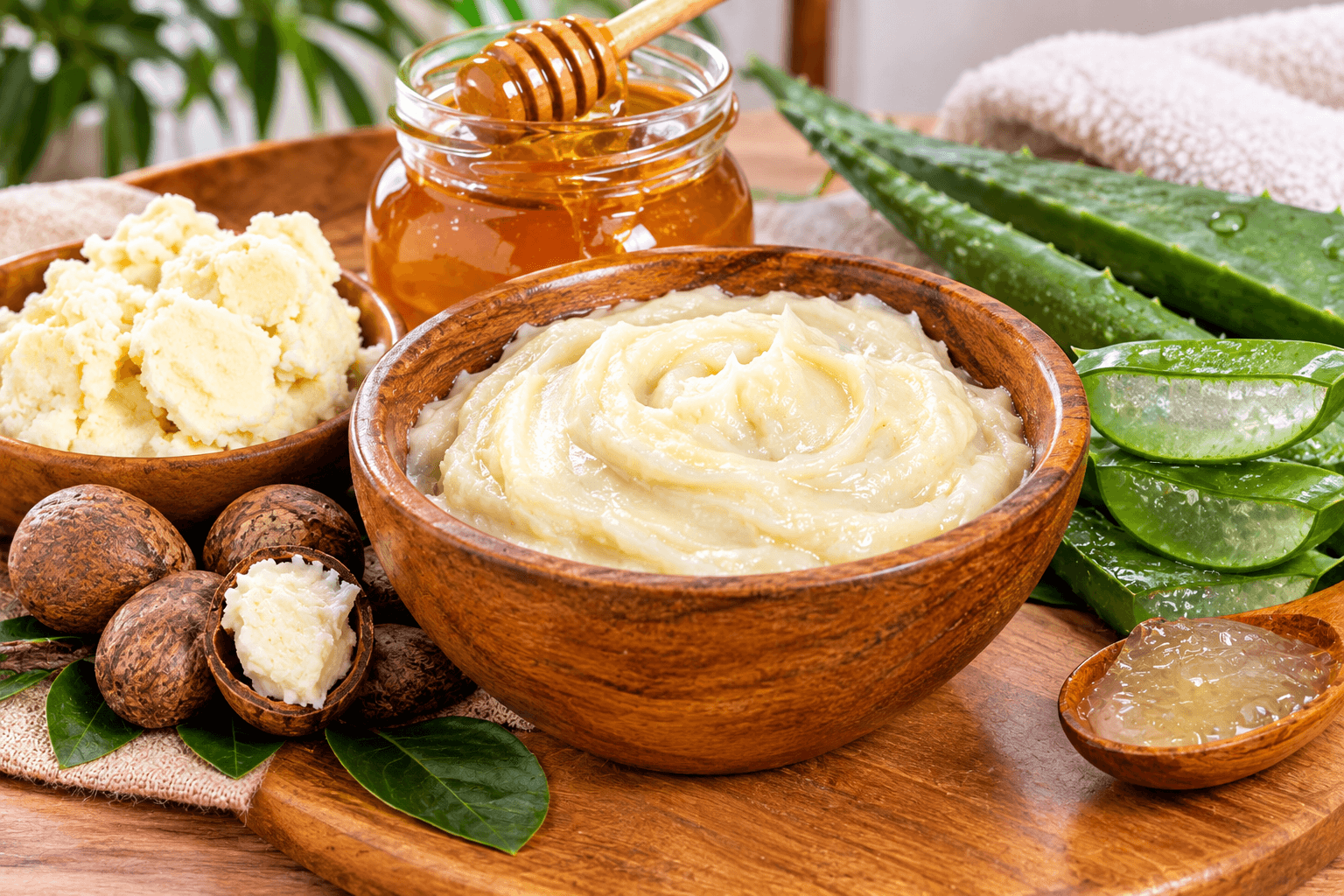
This recipe is specifically designed for the chronic dryness that affects most Nigerian natural hair. Specifically, it combines multiple humectants with deeply nourishing butters and oils for intensive, long-lasting moisture that transforms coily hair from dry and brittle to soft, defined, and manageable.
Makes: Enough for one full-head application (medium-length natural hair)
Ingredients:
- 3 tablespoons Natural Shea Butter (softened, not melted)
- 2 tablespoons Coconut Oil (melted)
- 1 tablespoon Sweet Almond Oil
- 2 tablespoons fresh aloe vera gel (or store-bought)
- 1 tablespoon honey
- 2 teaspoons Vegetable Glycerine
- 1 ripe avocado (mashed, optional but powerful addition)
Total cost: Approximately ₦500-₦800 per application
Step-by-Step Instructions:
Step 2: Combine Butter and Oils
In your mixing bowl, combine softened shea butter and melted coconut oil. Whisk together until smooth and fully blended. Additionally, ensure shea butter is soft but not completely liquid for the best texture.
Step 3: Add Remaining Ingredients
Add sweet almond oil, aloe vera gel, honey, and vegetable glycerine. If using avocado, mash it thoroughly first and add to the mixture. Whisk all ingredients together vigorously until you have a smooth, creamy consistency with no lumps.
Texture tip: If the mixture is too thick to spread easily, add 1-2 tablespoons of warm water and whisk again. Consequently, a spreadable consistency ensures even distribution throughout your hair.
Step 4: Apply Generously to Dry or Damp Hair
Unlike the protein mask which requires damp hair, this moisture mask can be applied to either dry or damp hair. However, applying to damp hair generally gives better distribution and penetration. Specifically, section hair into 4-6 parts and apply generously from roots to ends.
For very dry natural hair, use more product than you think necessary. Furthermore, really work the mask into each section using your fingers, ensuring it reaches every strand including the innermost parts of each curl.
Step 5: Processing Time (Longer is Better)
Cover with a shower cap and apply heat for 30-45 minutes for best results. This moisture mask benefits from longer processing time than the protein mask. Consequently, leaving it on for the full 45 minutes with heat produces noticeably better results than shorter processing.
Extended treatment option: For severely dry hair, apply the mask and leave overnight without heat (just the shower cap). Then, rinse in the morning. This extended contact time allows maximum moisture delivery. Furthermore, many natural hair enthusiasts swear by overnight masking for the most dramatic transformation.
Step 6: Rinse and Style
Rinse thoroughly with cool water. Unlike the protein mask, you won’t need extra conditioner because this mask is already a complete conditioning treatment. Apply your leave-in conditioner and seal with a light oil before styling.
What you’ll notice immediately: Significantly softer, more defined curls with dramatically reduced frizz. Additionally, hair should feel more elastic and spring back when stretched rather than breaking. Furthermore, this softness should last 3-5 days longer than regular conditioner alone.
Frequency: Once weekly for very dry natural hair. Every 2 weeks for moderately dry hair.
Recipe 3: Natural Hair Mask Scalp Growth Stimulating Formula (Bonus Recipe!)
This specialized mask targets the scalp specifically rather than the hair length. Consequently, it’s designed to create the optimal scalp environment for maximum hair growth by combining circulation-boosting, antimicrobial, and nourishing ingredients.
Makes: Enough for scalp treatment (not full hair length)
Ingredients:
- 3 tablespoons Coconut Oil (base oil)
- 1 tablespoon castor oil (circulation booster)
- 1 tablespoon Sweet Almond Oil (lightweight nourishment)
- 2 tablespoons fresh aloe vera gel (soothing base)
- 1 teaspoon Vegetable Glycerine
- 15 drops rosemary essential oil (proven growth stimulant)
- 8 drops peppermint essential oil (circulation booster)
- 5 drops tea tree essential oil (scalp health)
Total cost: Approximately ₦600-₦900 per application
Instructions:
Step 1: Combine all oils in a bowl. Add aloe vera gel and glycerine. Whisk until thoroughly combined.
Step 2: Add essential oils and stir well. Specifically, the rosemary and peppermint oils are the key growth-stimulating ingredients. Research confirms rosemary oil is as effective as minoxidil for promoting hair growth when used consistently.
Step 3: Part hair into sections and apply ONLY to the scalp using your fingertips or a dropper bottle. Do not apply to the hair length because this formula is too heavy for hair strands.
Step 4: Massage thoroughly into the scalp for 10-15 minutes using firm circular motions. This massage is crucial because it stimulates blood circulation independently of the ingredients.
Step 5: Leave on for 30-60 minutes. You’ll feel a pleasant tingling sensation from the peppermint oil that indicates increased blood flow to the scalp. Cover with a shower cap during this time.
Step 6: Shampoo thoroughly to remove all oils. Follow with your regular conditioner.
Frequency: Once weekly as a standalone scalp treatment before washing.
How to Use Hair Masks for Different Nigerian Hair Types
For Natural Hair (4C, 4B, 4A)
Highly textured natural hair benefits most from the deep moisture mask (Recipe 2). Specifically, use it every wash day for severely dry hair. Furthermore, alternate between the protein mask (Recipe 1) and moisture mask every other week to maintain the optimal protein-moisture balance.
Application technique: Apply mask to each section in 4-strand twists. Specifically, this technique ensures the mask reaches the inner strands of densely coiled hair that can be hard to saturate with normal application. Consequently, you get even distribution throughout your entire head.
For Relaxed Hair
Relaxed hair needs protein support consistently because the chemical process permanently alters the hair’s protein structure. Therefore, use Recipe 1 (protein mask) every 2 weeks and Recipe 2 (moisture mask) on alternate weeks. Furthermore, never skip the protein mask for more than 3 consecutive weeks because relaxed hair is vulnerable to hygral fatigue without regular protein input.
For Transitioning Hair
Transitioning hair needs both protein and moisture in equal measure because you’re managing two very different hair textures simultaneously. Consequently, alternate between Recipe 1 and Recipe 2 every week. Additionally, focus extra mask time on the line of demarcation where breakage is most likely.
For Low-Porosity Hair
Low-porosity hair resists moisture absorption because the cuticle lies flat. Therefore, always use heat with your hair mask. Furthermore, use lighter formulations by reducing shea butter and increasing aloe vera and glycerine. Consequently, lighter ingredients penetrate the resistant cuticle more effectively than heavy butters.
For High-Porosity or Damaged Hair
High-porosity hair absorbs moisture quickly but loses it equally fast. Therefore, prioritize protein treatments (Recipe 1) to fill gaps in the damaged cuticle. Additionally, always seal with a heavy butter or oil after rinsing to slow moisture loss. Furthermore, use Recipe 2 (moisture) immediately after protein treatments to prevent protein overload.
How Often Should You Mask?
Getting the frequency right is just as important as the recipe itself.
Every wash day (weekly): Severely dry or damaged hair, highly textured 4C natural hair, transitioning hair, hair that breaks consistently during styling.
Every 2 weeks: Moderately dry hair, relaxed hair, natural hair that’s in reasonable condition but needs improvement.
Once monthly: Healthy hair in maintenance mode, hair that responds well to regular conditioner alone.
Signs you need MORE frequent masking:
- Hair breaks during gentle detangling
- Shrinkage is extreme and hair feels brittle
- Hair refuses to retain moisture beyond one day
- Relaxed hair stretches and snaps rather than stretching and returning
Signs you need LESS frequent masking:
- Hair feels stiff or hard after treatment (protein overload)
- Hair is dry and tangly even with frequent masking (try balancing with moisture)
- Scalp feels irritated or sensitive
Troubleshooting Your Natural Hair Mask
Problem: Hair feels stiff and hard after protein mask
Why: Protein overload from too frequent use or too much protein in one application.
Fix: Do an intensive moisture treatment (Recipe 2) immediately. Specifically, moisture counteracts protein overload. Furthermore, reduce protein mask frequency to once monthly and monitor hair response.
Problem: Mask is too thick to distribute evenly through hair
Why: Too much shea butter or the mixture is too cold.
Fix: Warm the mixture slightly by placing the bowl in hot water for 2-3 minutes. Additionally, add a tablespoon of warm water and stir to thin the consistency. Consequently, a pourable consistency distributes far more evenly than a thick paste.
Problem: Egg smell remains after rinsing
Why: Insufficient rinsing or warm water was used first which cooked egg protein onto hair.
Fix: Always rinse protein masks with cool water first. Then shampoo the hair. Furthermore, add a few drops of peppermint or lavender essential oil to the mask next time to counteract the egg scent.
Problem: No visible improvement after 4 weeks
Why: Wrong mask type for your hair’s needs, insufficient processing time, or mask applied without heat.
Fix: Assess whether your hair needs protein or moisture (not both at once). Apply heat during every session. Furthermore, extend processing time to 45 minutes minimum and add heat for better ingredient penetration.
Problem: Mask is causing breakouts on forehead and neck
Why: Ingredients in the mask (particularly oils) are contacting facial and neck skin during rinse-out.
Fix: Apply a small amount of your regular face cream around your hairline before masking to create a barrier. Furthermore, rinse mask out carefully directing water backward rather than forward over your face.
Packaging and Selling Your Natural Hair Masks
Natural hair masks are excellent products for Nigerian beauty entrepreneurs. Here’s exactly how to make them commercially successful.
Two Business Models:
Model 1: Ready-to-Use Masks
Make masks in bulk, package in wide-mouth jars, and sell ready for immediate customer use. Specifically, this works best for oil-based masks without eggs that have longer shelf lives.
Model 2: Dry Mask Kits
Package the dry and stable ingredients (shea butter, oils, dried herbs) in a kit with instructions. Customers add fresh ingredients (eggs, honey, yogurt) at home. Consequently, shelf life is significantly extended and production is simpler.
Shelf Life Considerations:
Oil-based masks (Recipe 3): 3-6 months with proper preservation.
Butter-based masks (Recipe 2 without eggs): 2-4 months when properly preserved.
Protein masks with eggs: Make fresh for each use. Do NOT sell pre-made egg-based masks because of extremely short shelf life and food safety concerns.
Pricing:
Cost breakdown per 150ml jar (oil-based mask):
- Ingredients: ₦800-₦1,200
- Jar and label: ₦400-₦600
- Total cost: ₦1,200-₦1,800
Recommended retail prices:
- Basic moisture mask (150ml): ₦3,000-₦4,500
- Growth stimulating scalp mask (100ml): ₦3,500-₦5,000
- Complete hair mask kit (dry ingredients): ₦2,500-₦3,500
Profit per unit: ₦1,200-₦3,200 depending on recipe and positioning
Scale example: Sell 25 moisture masks monthly at ₦4,000 each = ₦100,000 revenue, approximately ₦70,000 profit. That’s excellent income for a simple product!
Marketing Your Natural Hair Masks:
Position them as “made specifically for Nigerian natural and relaxed hair” rather than generic hair masks. Additionally, create before-and-after content showing hair transformation after 4-8 weeks of weekly masking. Furthermore, target natural hair communities on Instagram and TikTok where Nigerian natural hair enthusiasts are extremely active and receptive to new products.
Your Complete Natural Hair Care System
With your natural shampoo, conditioner, and now hair mask all published, you’ve built a complete natural hair care system that customers can use from start to finish.
Your complete natural hair care routine:
- Natural Shampoo (weekly)
- Natural Hair Mask (weekly, after shampoo)
- Natural Conditioner (every wash day)
- Natural Leave-In Spray (between wash days)
- Hair Growth Oil (2-3 times weekly)
This complete system addresses every aspect of Nigerian hair health simultaneously. Consequently, customers who follow all five steps consistently achieve results that simply aren’t possible with any single product alone.
Your Action Plan: Make Your First Mask This Weekend
You now have three complete natural hair mask recipes covering every major Nigerian hair concern.
First, assess your hair’s primary need. Does it break easily (protein mask)? Is it chronically dry (moisture mask)? Is it growing slowly (scalp growth mask)? Start with the recipe that addresses your most pressing concern.
Second, gather your ingredients. Most are available in your kitchen right now (eggs, honey, yogurt). The specialty oils are available from your cosmetic raw materials supplier.
Third, commit to masking weekly for 8 weeks before evaluating results. Take photos before and after each session. Specifically, focus on breakage during detangling and overall softness as your primary progress indicators.
Fourth, introduce the complete hair care system gradually. Add the mask to an existing wash day routine rather than overhauling everything simultaneously.
Finally, share your results with the natural hair community. Nigerian natural hair groups on WhatsApp and Facebook are always looking for affordable, effective recipes that actually work for our hair type.
Ready to start? Get your quality ingredients:
- Natural Shea Butter – Deep conditioning base for moisture mask
- Coconut Oil – Penetrating treatment for all three recipes
- Sweet Almond Oil – Lightweight nourishment for all recipes
- Vegetable Glycerine – Essential humectant for all three recipes
Have you tried making natural hair masks at home before? Which recipe are you most excited to try? Share your experience in the comments below. Our community of 5,000+ Nigerian beauty enthusiasts would love to hear from you!